Vehicle-wrap film follows the surface underneath it.
It does not fill scratches, level dents, stop corrosion, secure peeling clear coat, or strengthen poorly bonded repainting. In many cases, the wrap makes existing imperfections more noticeable because its gloss and color reflect light across the damaged area.
Some vehicles with minor cosmetic wear can still be wrapped. Others should be repaired and refinished first.
The decision depends on:
- Type of damage
- Paint stability
- Surface smoothness
- Repair history
- Graphic coverage
- Material
- Expected service period
- Future removal risk
At Pixel Wraps, we inspect the vehicle before installation and document visible concerns. If a surface is not suitable, we recommend repair rather than covering a problem that may affect the wrap or vehicle.
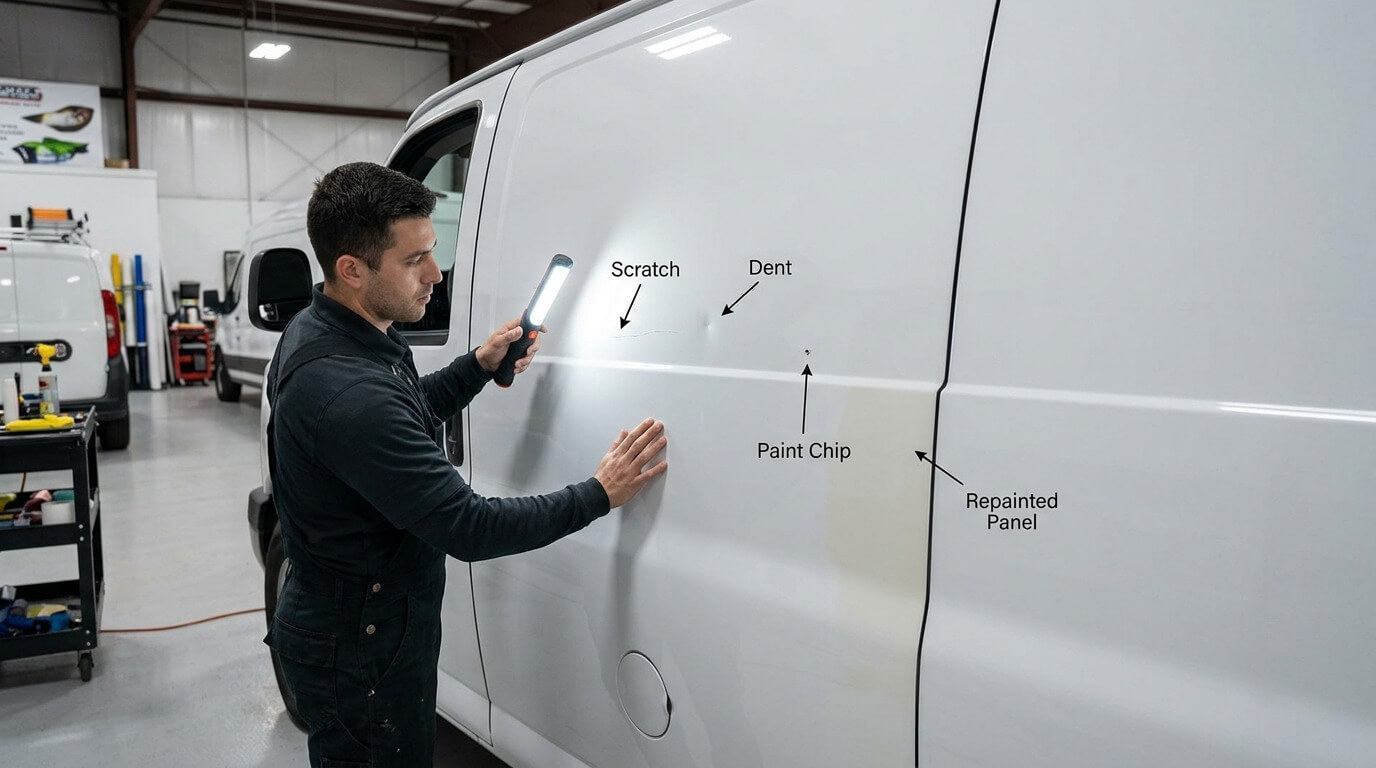
The Best Wrap Surface Is Smooth, Clean, Stable OEM Paint
Professional vehicle-wrap films generally perform best on sound original-equipment-manufacturer paint.
The surface should be:
- Smooth
- Fully cured
- Properly bonded
- Free of rust
- Free of peeling clear coat
- Clean and dry
- Free of wax and silicone
- Compatible with the selected adhesive
3M’s current vehicle-preparation guidance states that wrap films provide the best results on a like-new vehicle finish. It also explains that rust, bubbling, scratches, dents, and other damage can remain visible and may contribute to premature film problems.
See the 3M Vehicle Preparation for Success Guide and 3M Protection Wrap Film Installation Guide.
A vehicle does not need to be new, but the surface receiving vinyl needs to be stable.
Can You Wrap Over Scratches?
The answer depends on the scratch.
Light Clear-Coat Scratches
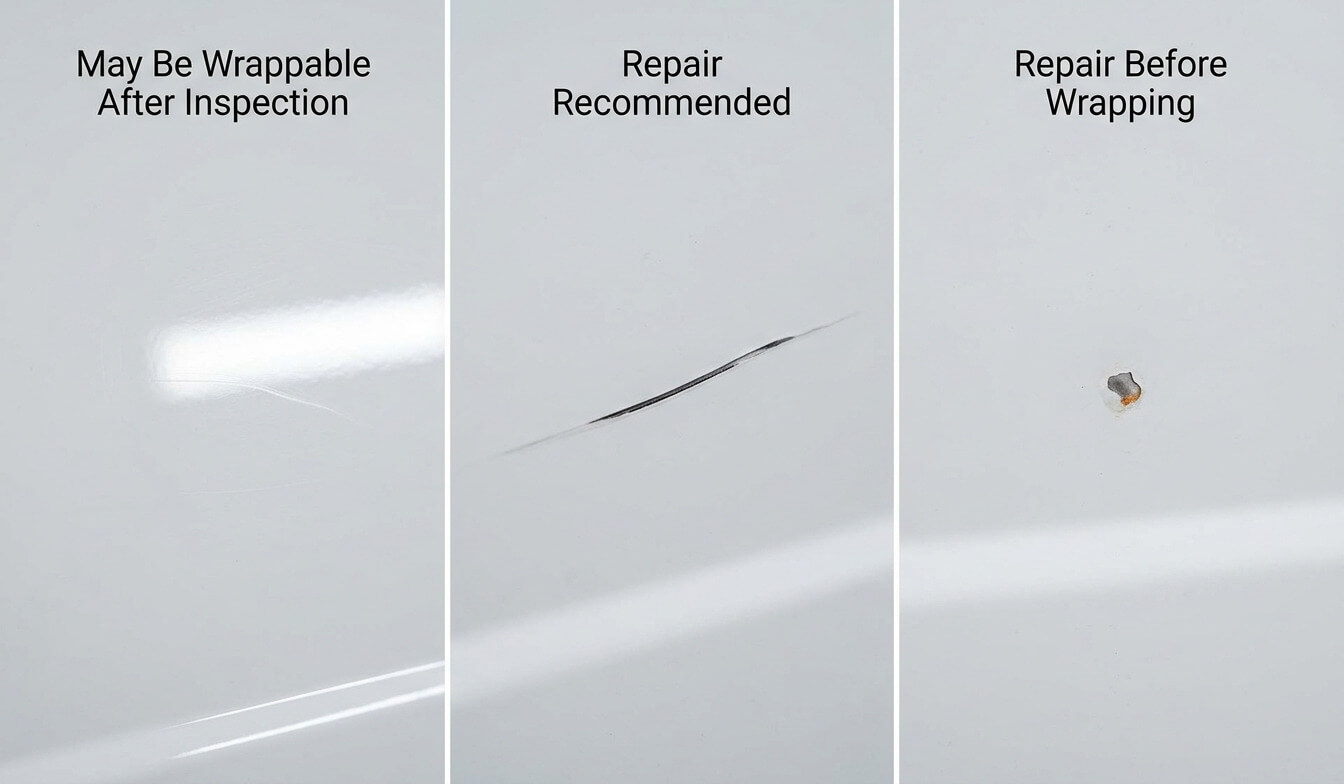
A shallow scratch limited to the clear coat may be wrappable if:
- The surrounding clear coat is stable
- No paint is lifting
- The surface is reasonably smooth
- The customer accepts that the line may remain visible
Wrapping does not remove the scratch. Depending on lighting and laminate finish, the film may show the same line beneath it.
Gloss and dark films can make surface irregularities more noticeable.
Deep Scratches
A scratch that cuts through the color coat or exposes primer, metal, plastic, or fiberglass should be evaluated and repaired before wrapping.
Possible concerns include:
- Corrosion
- Loose paint edges
- Adhesive bonding to several unstable layers
- Visible indentation
- Paint removal during film repositioning or future removal
Paint Chips
Rock chips and missing paint create small depressions and exposed edges.
Vinyl may bridge over the chip, but it will not level the surface. The chip can remain visible and may create a weak area.
If bare metal is exposed, corrosion should be addressed before wrapping.
Sanding a Scratch Is Not Always Enough
A surface can feel smooth after sanding while remaining unsuitable because it contains:
- Bare metal
- Exposed primer
- Feathered paint edges
- Unsealed filler
- Uncured refinishing materials
A qualified body or paint professional should determine the correct repair and refinishing process.
Can You Wrap Over Dents?
Vinyl conforms to the shape of a dent. It does not pull the metal flat or hide the contour.
Small Shallow Dents
A small shallow dent may be wrapped if:
- Paint is intact
- No sharp crease exists
- The surface is stable
- The customer accepts that the dent will remain visible
- The installer can apply film without excessive tension
Printed patterns can distract the eye from a minor dent, but that is visual camouflage—not repair.
Sharp or Creased Dents
A sharp dent can create several problems:
- Film may bridge the low area
- Vinyl may require excessive stretch
- A crease can remain obvious
- Damaged paint may lift
- The film may pull away later
- The design may distort
Professional dent repair should normally occur first.
Dents Near Body Edges
Damage near doors, wheel arches, seams, handles, or corners can affect panel finishing and movement.
A dent beside a door gap may prevent a clean edge termination even when the central area appears wrappable.
Repair First When Possible
Paintless dent repair may be an option when the paint is intact and the damage qualifies. More serious dents may require conventional body repair and refinishing.
The body shop—not the wrap provider—should determine the proper repair method.
Can You Wrap Over Rust?
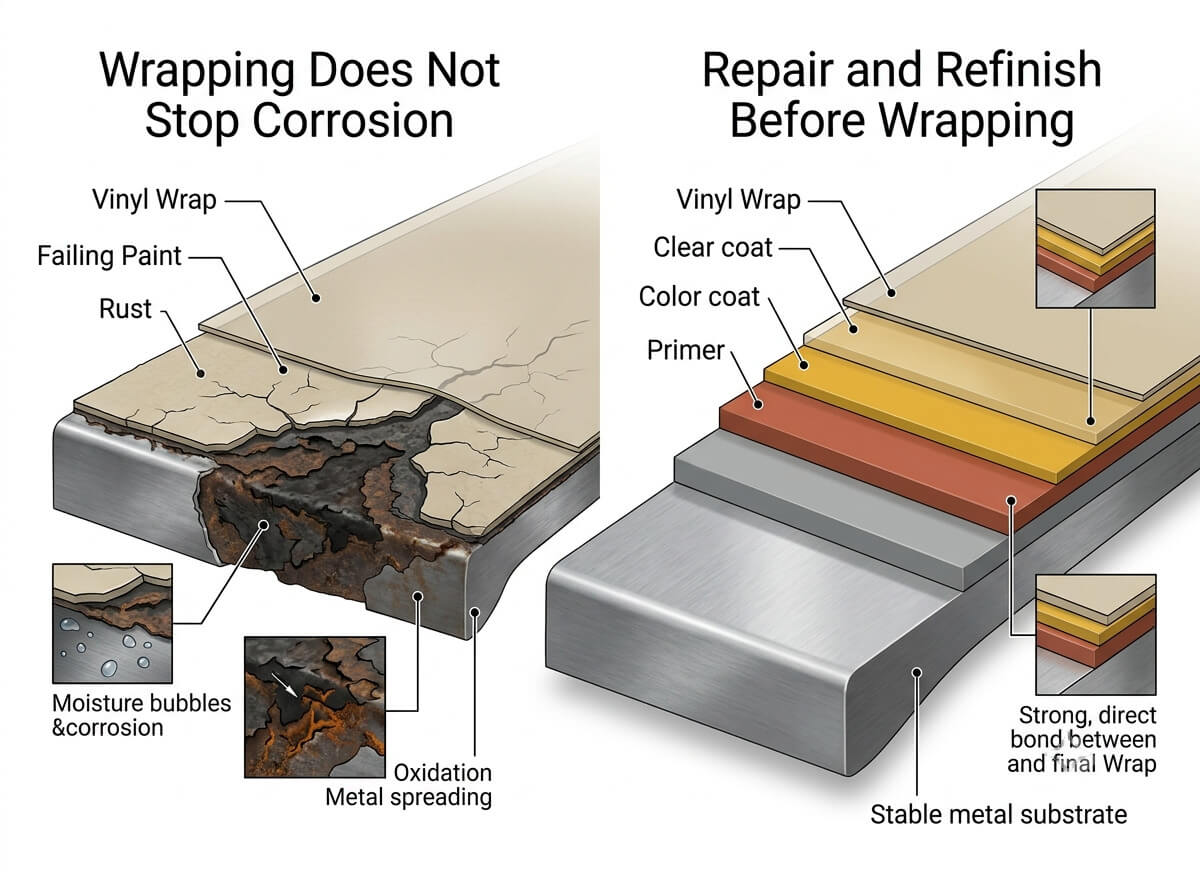
Rust should be repaired before vehicle-wrap installation.
Vinyl does not:
- Stop corrosion
- Remove moisture
- Strengthen rusted metal
- Rebuild missing paint
- Prevent corrosion from spreading underneath
- Create a stable paint bond
Covering rust can hide the progression while the metal continues deteriorating.
Surface Rust
Even small visible surface rust indicates that the protective paint system has failed.
The affected area should be professionally:
- Evaluated
- Cleaned to stable material
- Treated as required
- Primed
- Refinished
- Fully cured
Bubbling Paint
Bubbles beneath paint can indicate corrosion, moisture, or loss of adhesion.
Applying vinyl over bubbling paint may temporarily cover the appearance, but the adhesive is bonding to an unstable paint layer.
The paint can separate with the film during installation or removal.
Rust at Seams and Edges
Rust commonly develops around:
- Wheel arches
- Lower doors
- Rocker panels
- Body seams
- Roof gutters
- Service-body joints
- Collision repairs
These are also demanding wrap areas. The corrosion must be repaired before a reliable edge can be produced.
ORAFOL’s current vehicle-film installation guidance states that vehicle paint should not be damaged by rust, scratches, stone chips, age-related deterioration, or similar defects.
See the ORAFOL Vehicle Film Installation Guidelines.
Can You Wrap Over Peeling Clear Coat?
No professional provider should treat peeling clear coat as a stable wrap surface.
When vinyl is applied:
- The adhesive may bond to loose clear coat
- Repositioning can pull additional clear coat away
- Bubbles or texture may remain visible
- The wrap can lift with the failing coating
- Removal may take paint and clear coat with it
The problem is not the vinyl’s adhesive strength. The problem is the weak bond between the vehicle’s coating layers.
The panel should be professionally refinished and fully cured before wrapping.
A waiver can document that the customer understands the risk. It does not make the surface technically sound.
Can You Wrap Over Body Filler or Primer?
Unfinished body filler is not an appropriate final wrap surface.
Body filler can be:
- Porous
- Dusty
- Uneven
- Moisture-sensitive
- Weakly bonded at feathered edges
- Incompatible with the intended adhesive
3M’s current installation guidance states that body-filler repairs should be sanded and epoxy primed, and recommends finishing with an appropriate paint or clear coat for best results. Newly applied finishes must be fully cured according to the paint manufacturer.
Primer alone may not provide the same surface quality, stability, or removal behavior as a complete automotive finish.
The safer process is normally:
- Complete the body repair
- Sand the surface properly
- Apply the required primer
- Apply the compatible automotive color and clear coat
- Allow complete curing
- Inspect the finish
- Wrap the stable surface
The wrap should not be used as the final step of an unfinished body repair.
Can You Wrap a Repainted Vehicle?
A professionally repainted panel may be wrappable, but it carries additional risk compared with stable factory paint.
Important questions include:
- Who performed the repaint?
- What paint system was used?
- Was the surface prepared correctly?
- Was the panel baked or air dried?
- How long has it cured?
- Is the clear coat stable?
- Was body filler used?
- Is overspray present?
- Has adhesion been tested?
- Are there feathered repair edges?
Fully Cured Repainting
Repainted panels should not be wrapped until the paint system has fully cured according to the paint manufacturer or qualified body shop.
There is no reliable universal waiting period for every repaint.
Curing depends on:
- Paint chemistry
- Product system
- Number of coats
- Temperature
- Humidity
- Baking
- Film thickness
- Body-shop procedures
The body shop that performed the work should provide the curing requirement.
Repaint Removal Risk
Even a good-looking repaint can have weaker adhesion than the original factory coating.
During future wrap removal, the vinyl may pull:
- Clear coat
- Color coat
- Primer
- Feathered repair edges
- Filler-related coating sections
Avery Dennison’s North American vehicle-wrap guidelines require pre-installation paint inspection and warn that chipped paint, rust, dents, and non-OEM repainting can create a high risk of paint damage during graphic removal.
See the Avery Dennison Vehicle Wrap Guidelines.
Test Applications Have Limits
A test patch may help evaluate immediate adhesive behavior, but it cannot guarantee how every section of the repaint will respond after years of exposure.
The repair may contain different paint adhesion at different edges or bodywork areas.
What About Orange Peel, Fisheyes, and Uneven Paint?
Wrap film can reproduce the texture of the surface beneath it.
Visible paint defects may include:
- Orange peel
- Sanding marks
- Fisheyes
- Runs
- Dust nibs
- Pitting
- Uneven filler
- Overspray
- Polishing trails
High-gloss wrap finishes can make these defects more noticeable.
A printed commercial graphic may visually distract from minor texture, but the physical irregularity remains.
Paint correction can address selected clear-coat defects, while deeper problems may require refinishing. The correct process should be determined by a qualified paint professional.
Ceramic Coatings, Wax, and Paint Sealants
A vehicle can have visually perfect paint and still be unsuitable for immediate wrapping if the surface contains:
- Ceramic coating
- Wax
- Silicone
- Polish
- Paint sealant
- Tire dressing overspray
- Detailing products
These substances can reduce surface energy and prevent the adhesive from bonding properly.
Some coatings require mechanical removal through professional polishing rather than ordinary cleaning.
The owner should disclose any recent detailing or coating treatment before bringing the vehicle for installation.
The wrap provider should confirm that the surface is ready rather than assuming a shiny vehicle is clean.
Will a Wrap Hide Damage?
A wrap may change how the eye notices damage, but it does not physically repair it.
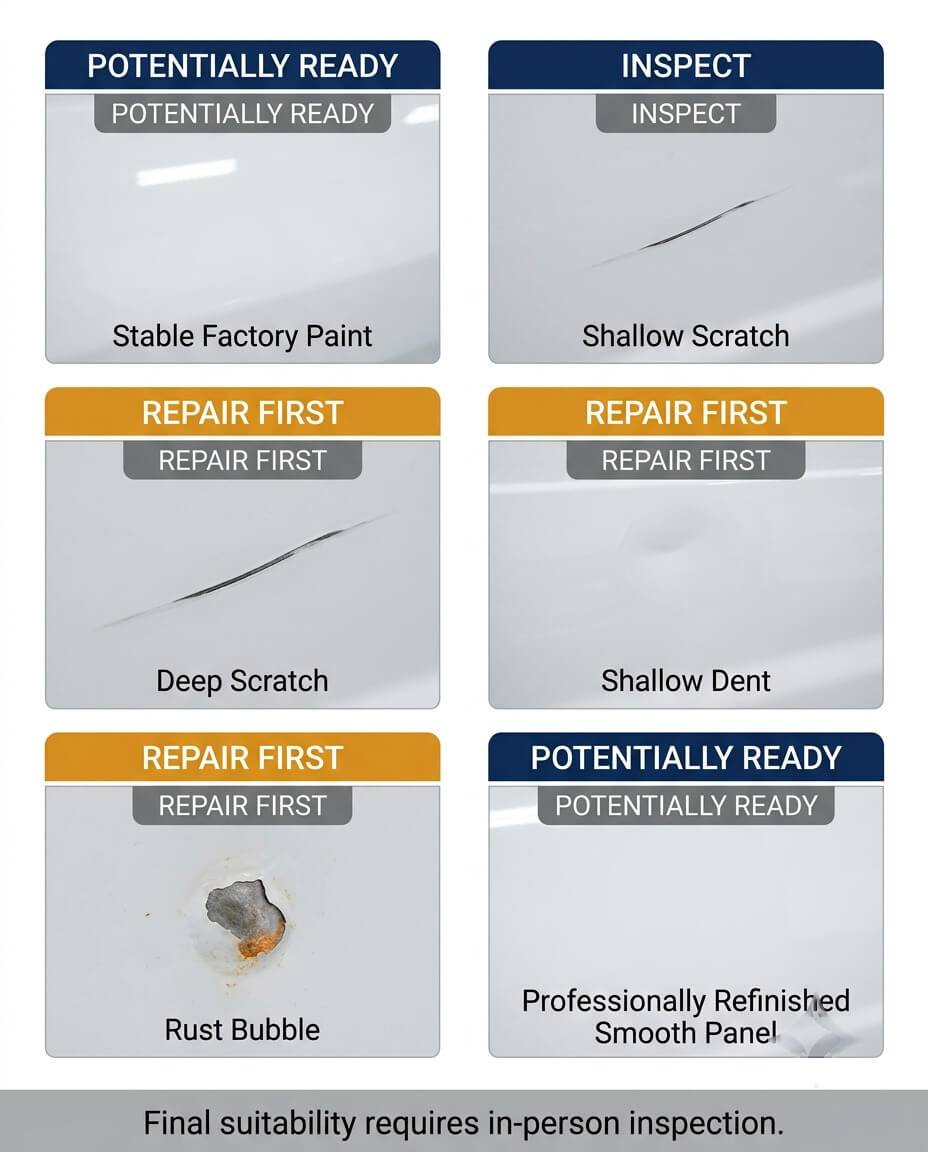
| Vehicle condition | Can it be wrapped? | Expected result |
| Very light clear-coat scratch | Possibly, after inspection | Scratch may remain visible |
| Deep scratch through paint | Repair first | Prevents visible defect and exposed-surface risk |
| Small shallow dent with intact paint | Possibly, after inspection | Dent will remain visible |
| Sharp or creased dent | Repair first | Film may distort, bridge, or remain under tension |
| Paint chip | Repair recommended | Depression and loose edge may show through |
| Bare metal | Repair and refinish first | Prevents corrosion and creates a stable surface |
| Rust | Do not cover without repair | Vinyl will not stop corrosion |
| Bubbling paint | Refinish first | Unstable paint may separate |
| Peeling clear coat | Refinish first | Vinyl may lift with the coating |
| Unsealed body filler | Complete the repair first | Filler is not a stable finished wrap surface |
| Fully cured professional repaint | Possibly, with documented risk | Higher paint-removal risk than stable OEM paint |
| Fresh repaint | Wait for documented full cure | Early wrapping can affect paint and adhesion |
| Ceramic-coated paint | Coating may need removal | Adhesive may not bond correctly |
Why Damage Can Affect Wrap Removal
A vehicle may accept vinyl during installation but lose paint when the wrap is later removed.
Higher-risk areas include:
- Chipped paint
- Loose clear coat
- Repainted panels
- Filler edges
- Rust
- Previous adhesive damage
- Cracked paint
- Uncured repair work
The vinyl may be removable according to its technical specification while the paint underneath is not securely bonded.
“Removable adhesive” does not mean guaranteed damage-free removal from every surface.
Professional removal uses controlled heat and technique, but it cannot restore weak adhesion between the paint and vehicle.
Pre-Installation Documentation Protects Both Parties
The vehicle should be inspected with the customer before wrapping.
Documentation can include:
- Wide photographs of each side
- Close-ups of scratches and dents
- Paint-chip locations
- Rust
- Repainted panels
- Existing clear-coat problems
- Body filler or repairs
- Vehicle identification
- Date
- Written condition notes
- Customer acknowledgment
Avery Dennison’s vehicle-wrap guidelines specifically recommend recording suspect areas, taking photographs, and obtaining a signed pre-application examination.
Documentation does not improve the paint. It establishes what was visible before installation and helps guide material, warranty, and removal discussions.
When Pixel Wraps May Decline to Wrap a Panel
We may recommend repair or decline installation when:
- Rust is active
- Clear coat is peeling
- Paint is visibly unstable
- Repainting has not fully cured
- Body filler is unfinished
- Bare metal is exposed
- Severe dents prevent reliable film placement
- The surface is heavily textured or contaminated
- A coating cannot be removed
- The customer expects the wrap to function as body repair
- Removal risk is unreasonably high
- The surface falls outside the material’s approved application
Declining an unsuitable surface can prevent greater cost later.
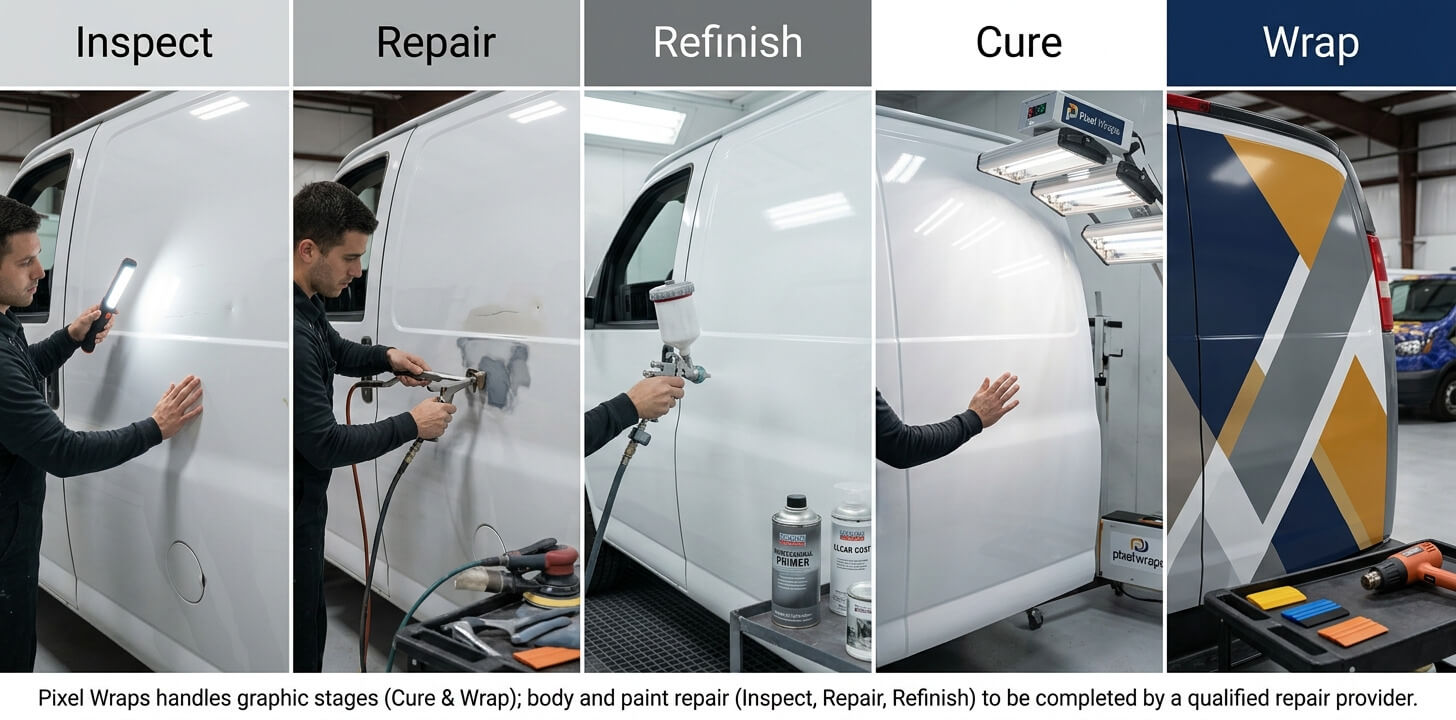
The Right Sequence: Repair, Cure, Then Wrap
When bodywork is required, the recommended project sequence is:
- Remove existing graphics from the repair area.
- Complete dent, rust, or collision repair.
- Apply the complete professional paint system.
- Allow the finish to cure according to the paint manufacturer.
- Inspect and clean the surface.
- Confirm wrap compatibility.
- Produce the graphics.
- Install in controlled conditions.
- Document the repaired and wrapped panel.
The body shop and wrap provider should coordinate before the vehicle is scheduled.
If the original graphic must be matched, Pixel Wraps also needs time to review the existing color, material, laminate, and panel layout.
How Pixel Wraps Evaluates Vehicle Condition
Our pre-wrap review can include:
- Confirming the vehicle year, make, and model
- Asking about repainting and collision repairs
- Reviewing visible scratches and chips
- Identifying dents and sharp creases
- Checking for rust and bubbling paint
- Looking for failing clear coat
- Identifying filler, primer, or unfinished repair areas
- Asking about ceramic coating and detailing products
- Photographing visible concerns
- Explaining appearance and removal risks
- Recommending repair when necessary
- Confirming the final graphic scope
An inspection can identify visible warning signs. It cannot guarantee the hidden adhesion of every paint or repair layer.
Inspect the Surface Before Designing the Wrap
Vehicle condition can affect more than installation.
It may also affect:
- Graphic coverage
- Panel placement
- Seam locations
- Repair scope
- Production schedule
- Quote
- Warranty eligibility
- Removal expectations
- Vehicle downtime
For that reason, surface problems should be addressed before final production approval.
A design should not be printed for a damaged panel that may later require bodywork and different measurements.
Get a Pre-Wrap Vehicle Inspection From Pixel Wraps
If your commercial vehicle has scratches, dents, rust, repainting, peeling clear coat, body filler, or previous collision work, tell us before production begins.
Pixel Wraps can inspect the vehicle and explain whether the affected area is:
- Suitable as-is
- Wrappable with documented limitations
- In need of paint correction
- In need of body repair
- In need of complete refinishing
- Better excluded from the graphic scope
Contact our team to schedule an inspection and plan the wrap after the surface is ready.