A vehicle wrap commonly begins showing trouble at an edge, seam, channel, or opening.
These are the areas where vinyl may encounter airflow, water, road contamination, physical contact, body movement, cleaning equipment, and installation tension. If the film did not establish a suitable bond—or if the edge is later damaged—it can begin lifting away from the vehicle.
Edge lifting should not be ignored.
A small loose section can collect dirt and moisture, catch during washing, and spread into a larger damaged area. Early inspection may allow a limited repair before the complete panel needs replacement.
At Pixel Wraps, edge-lift prevention begins with vehicle inspection, material selection, controlled surface preparation, panel planning, professional installation, and final inspection.
This guide explains the common causes of lifting and what fleet owners should do when they notice it.
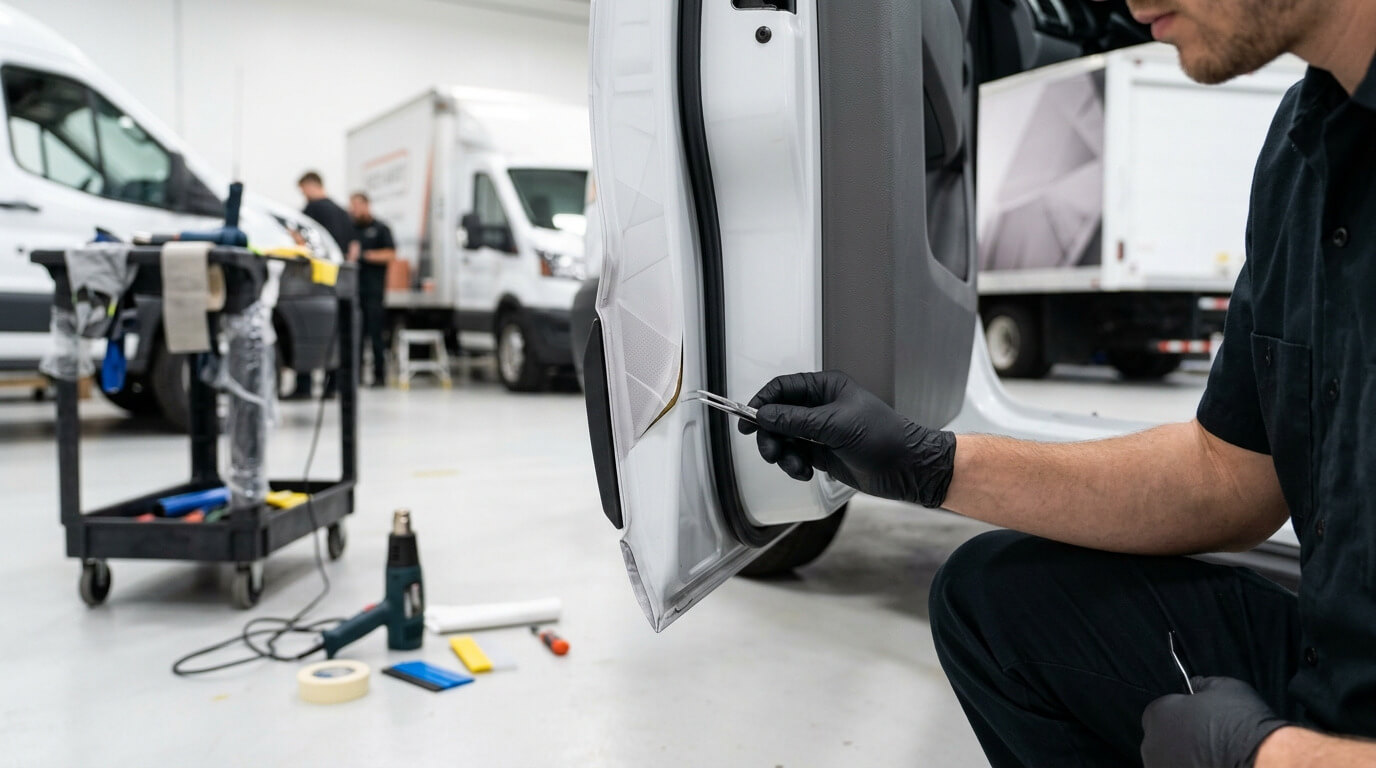
What Is Vehicle-Wrap Edge Lifting?
Edge lifting occurs when the adhesive-backed vinyl separates from the surface along an exposed boundary.
It can appear around:
- Doors
- Hoods
- Wheel arches
- Windows
- Body seams
- Handles
- Lights
- Fuel doors
- Bumpers
- Rooflines
- Panel overlaps
- Inlays
- Deep channels
- Riveted areas
- Trim openings
The lifted area may begin as a narrow raised line or small corner. As contamination collects beneath it, the adhesive may no longer be capable of rebonding cleanly.
Lifting inside a channel is related but may involve different causes, including excessive stretch, trapped tension, or inadequate post-heating.
A proper diagnosis considers the location, material, vehicle surface, installation method, exposure, and maintenance history.
Cause 1: Dirt, Wax, Oil, or Silicone at the Edge
Contamination is one of the most common reasons an edge fails to bond.
Vehicle edges and openings collect substances such as:
- Road dirt
- Grease
- Wax
- Polish
- Silicone
- Tire dressing
- Ceramic coatings
- Fuel residue
- Adhesive remover
- Soap
- Road salt
- Protective shipping compounds
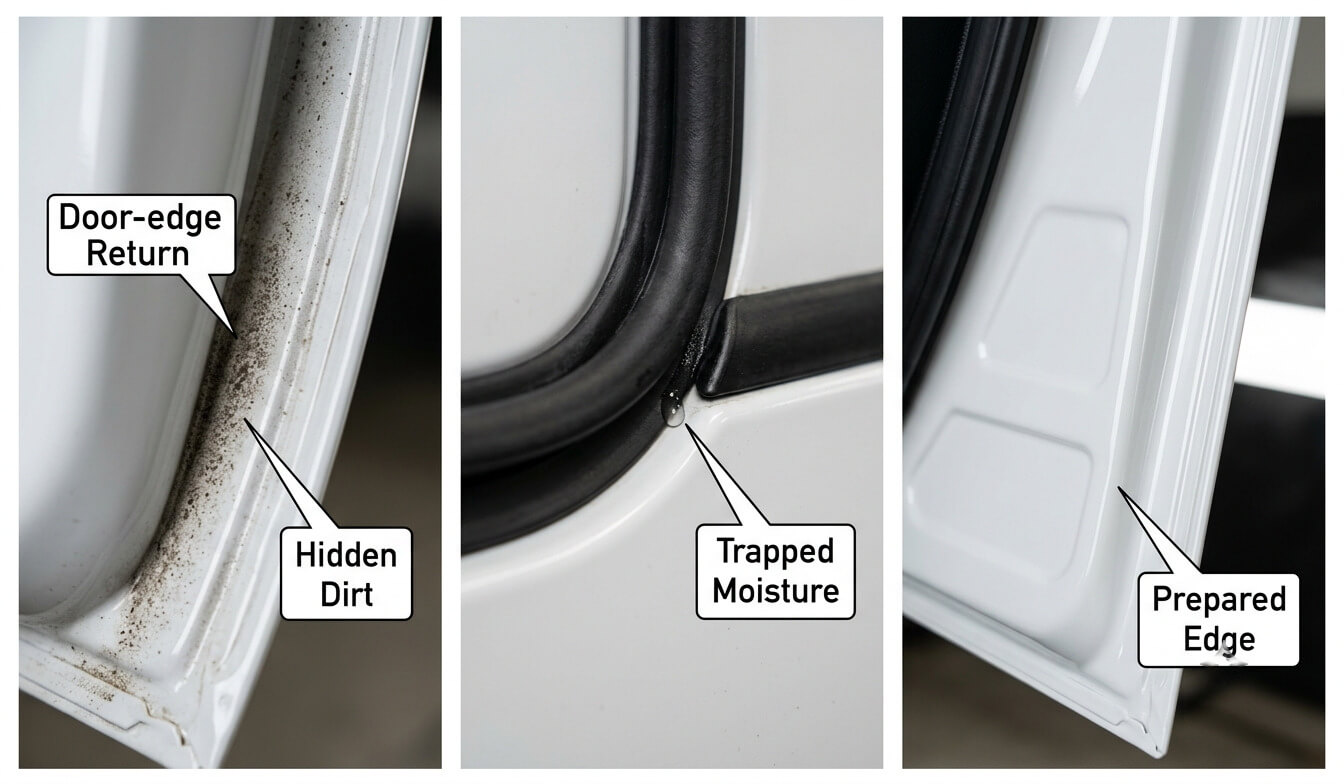
A large flat door surface can look clean while dirt remains hidden inside the door edge or beneath a rubber seal.
When vinyl is wrapped around the edge, the adhesive contacts that contamination instead of the vehicle surface.
3M’s panel-application guidance identifies dirt or other contamination as a common cause of lifting at seams and openings. It instructs installers to make sure contact areas are clean before finishing the film.
See 3M Instruction Bulletin 5.4.
Surface preparation must include the areas where the film will end—not only the visible center of the panel.
Cause 2: Moisture Trapped in Seams and Crevices
Water can remain around:
- Door handles
- Moldings
- Lights
- Mirrors
- Rubber gaskets
- Body seams
- Rivets
- Window edges
- Fuel doors
- Trim clips
The surface may appear dry until pressure or heat causes hidden water to emerge.
General Formulations’ current AutoMark Vehicle Wrap Application Guide warns that incomplete drying can interfere with installation and contribute to edge wing-up or lifting.
See the General Formulations AutoMark Vehicle Wrap Application Guide.
ORAFOL’s vehicle-wrap preparation guidance similarly states that moisture trapped in nooks and crevices can lead to poor adhesion.
See the ORAFOL Vehicle Wrap Processing and Handling Guide.
A vehicle should be washed, dried, acclimated, and given sufficient preparation time before film is applied.
Cause 3: Incorrect Material for the Surface
Not every vinyl bonds correctly to every vehicle component.
A commercial vehicle may include:
- Factory-painted metal
- Repainted panels
- Powder-coated surfaces
- Stainless steel
- Aluminum
- Fiberglass
- Textured plastic
- Low-surface-energy plastic
- Rubber
- Glass
A standard wrap film may bond well to sound factory paint but perform poorly on certain unpainted plastics or textured trim.
Selecting a more aggressive adhesive without evaluating removal and surface risk is not a complete solution.
The material must be approved for:
- The surface
- Vehicle body geometry
- Graphic coverage
- Expected service period
- Installation conditions
- Removal plan
An edge ending on an incompatible plastic or rubber component can lift even when the nearby painted panel remains secure.
Cause 4: Installation Below the Required Temperature
Cold vinyl becomes less flexible, and cold adhesive may not establish sufficient contact with the surface.
Possible results include:
- Weak initial bond
- Stiff edges
- Incomplete contact
- Trapped air
- Film pulling back from corners
- Edges releasing after the vehicle returns outdoors
A warm room is not enough if the metal body remains cold.
The vehicle, vinyl, and environment should be within the product-specific application conditions. The surface should also remain dry and above the dew point.
3M’s recess-application guidance calls for a clean, well-lit environment and provides a defined vehicle and ambient temperature range for the systems covered by that bulletin.
See the 3M Application on Substrates With Recesses Bulletin.
Climate-controlled installation helps create stable conditions, but the vehicle still needs time to acclimate.
Cause 5: Insufficient Squeegee Pressure
Pressure-sensitive adhesive requires firm, controlled pressure to establish contact with the surface.
A panel may look installed even when the adhesive has not been fully activated in selected areas.
Commonly missed areas include:
- Narrow edge returns
- Recess corners
- Overlaps
- Door openings
- Rivets
- Curved transitions
- Areas beside trim
3M’s current vehicle-application bulletin instructs installers to use firm, even, overlapping squeegee strokes. It notes that missed areas can leave wrinkles and bubbles where premature failure may occur.
See the 3M Application: Vehicles Instruction Bulletin.
Final inspection should include resqueegeeing appropriate edges, seams, and overlaps.
Cause 6: Excessive Stretch and Tension
Vinyl has a natural tendency to return toward its original shape after being stretched.
When the installer pulls material tightly around an edge or forces it into a deep recess, the film may remain under tension.
That tension can act against the adhesive.
High-risk locations include:
- Deep cargo-van channels
- Sharp corners
- Bumpers
- Mirrors
- Handle cups
- Wheel arches
- Roof transitions
- Narrow edge returns
Prevention can involve:
- Selecting a more conformable film
- Distributing stretch over a larger area
- Using an inlay
- Redesigning the panel
- Avoiding unnecessary one-piece coverage
- Following the manufacturer’s heat instructions
- Post-heating required areas
A seam or inlay can be more reliable than overstretching one piece of vinyl.
Cause 7: Incomplete Post-Heating
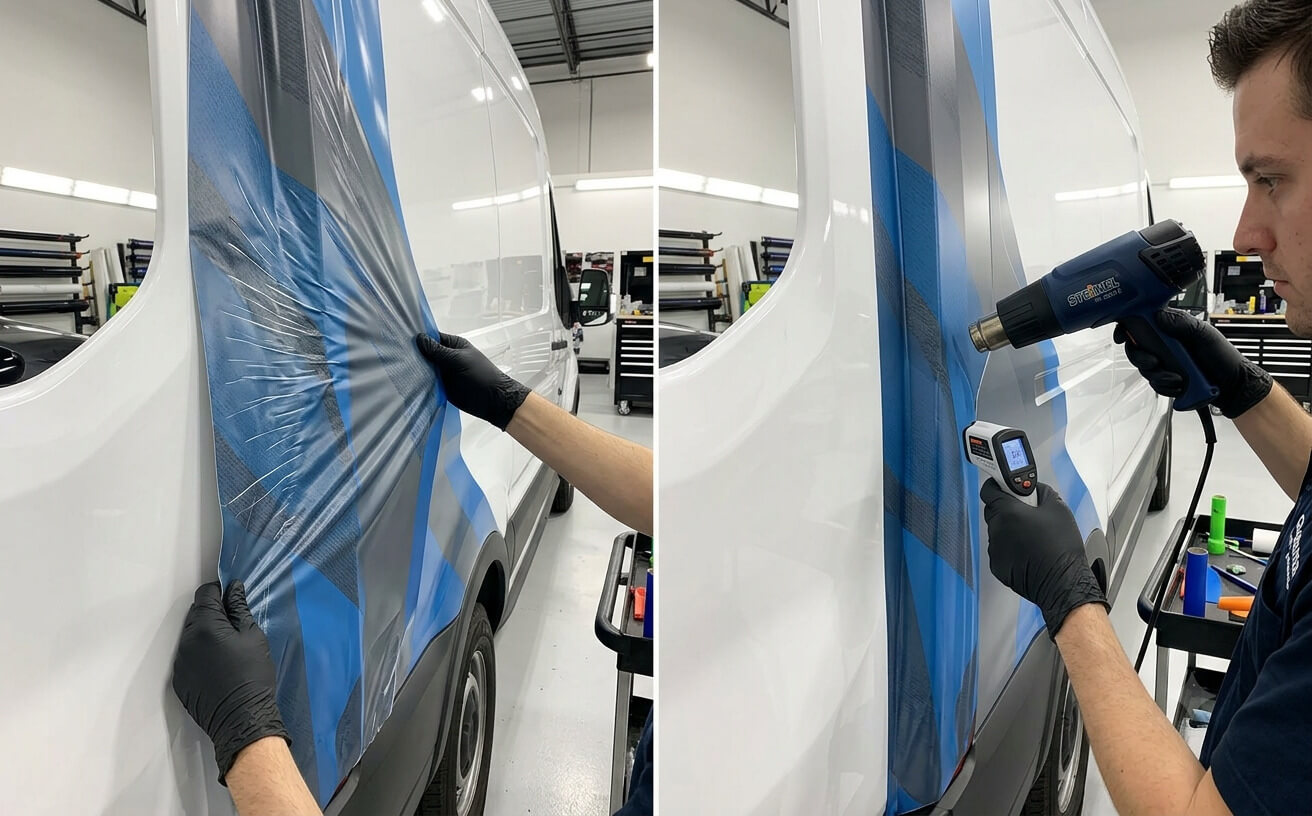
Some films require post-heating where the material has been stretched into recesses or around complex curves.
Post-heating is a controlled process intended to manage the film’s memory and reduce internal stress.
It must be:
- Required by the product instructions
- Applied to the appropriate area
- Measured at the film surface
- Performed to the correct temperature
- Followed by finishing and inspection
Randomly waving a heat gun over the wrap is not proper post-heating.
Insufficient post-heating can allow stretched material to pull back. Excessive heat can damage the film, laminate, ink, adhesive, or vehicle components.
The installer must follow the technical instructions for the exact film-and-laminate construction.
Cause 8: Poor Edge Placement
Where the vinyl ends can affect how the edge performs.
A vulnerable edge may be placed:
- Directly in airflow
- Where a brush repeatedly contacts it
- On a sharp exposed corner
- Across a moving body seam
- On incompatible trim
- Where water collects
- In a high-contact loading area
- Too close to a damaged paint edge
Professional panel planning can move the film termination to a more protected location or wrap the material around an appropriate edge when the product and vehicle allow it.
ORAFOL’s vehicle-wrap guidance advises against cutting solid-color film flush with the vehicle edge when an appropriate return can be used, because open edges can experience shrinkage, mechanical wear, cleaning-brush contact, and wind.
Product and project requirements differ. Not every commercial printed panel should be wrapped around every body edge.
The installer must consider the material, design, vehicle movement, and repair needs.
Cause 9: Incorrect Overlap Direction or Construction
Panel overlaps should be arranged so that normal airflow and water movement do not work directly against the exposed edge.
For many vehicle systems, vertical panels are installed from rear to front, while horizontal layouts proceed from bottom to top.
The overlap must also be:
- Wide enough for the selected product
- Clean before the upper panel is applied
- Free of contamination
- Properly pressured
- Finished according to the material instructions
An overlap that is too narrow can release. An unnecessarily large or poorly cleaned overlap can create other problems.
The product-specific application guide should establish the overlap requirements.
Cause 10: Pressure Washing and Brush Car Washes
A properly installed edge can be damaged through aggressive cleaning.
High-pressure water directed into the edge can force it away from the vehicle. Brushes can catch the edge or abrade the film.
3M’s current vehicle-application bulletin warns against directing high-pressure spray at graphic edges because it can cause lifting and film damage.
See the 3M Application: Vehicles Instruction Bulletin.
3M’s maintenance guidance also recommends hand washing when possible and notes that brush car washes may scratch the film or lift graphic edges.
See the 3M Graphics Maintenance Bulletin.
Fleet washing teams should receive wrap-specific care instructions instead of treating wrapped and unwrapped vehicles identically.
Cause 11: Physical Contact and Daily Fleet Use
Commercial vehicles work in demanding environments.
Edges may be damaged by:
- Loading equipment
- Toolboxes
- Ladders
- Cargo
- Tree branches
- Snow brushes
- Ice scrapers
- Fuel nozzles
- Boots and clothing
- Door contact
- Minor scrapes
- Repeated hand contact
Damage from physical use is different from spontaneous adhesive or material failure.
High-contact areas should be considered during design and panel planning. Drivers should report small cuts and loose edges before washing or continued use expands the damage.
Cause 12: Paint or Surface Failure
Sometimes the vinyl remains bonded to the paint, but the paint separates from the vehicle.
This can occur with:
- Repainted panels
- Failing clear coat
- Poor collision repair
- Uncured paint
- Rust
- Body filler
- Existing chips
- Weak adhesion between paint layers
The result may look like vinyl lifting, but inspection may show paint attached to the adhesive.
No wrap film can stabilize a failing paint system.
The vehicle’s condition should be inspected and documented before installation. Known repainting or bodywork should be disclosed to the wrap provider.
Cause 13: Aging Beyond the Intended Service Period
Vinyl, adhesive, ink, and laminate change over time.
As a wrap ages, edges can become more vulnerable because of:
- Film shrinkage
- Adhesive aging
- UV exposure
- Repeated temperature cycles
- Abrasion
- Cleaning
- Existing small damage
- Extended horizontal exposure
A wrap should be inspected and removed or replaced within a planned service cycle.
Leaving a graphic installed indefinitely can make both edge performance and eventual removal less predictable.
How Professional Installers Reduce Edge-Lifting Risk
A professional process includes multiple preventive stages.
Before Installation
- Confirm the correct film and laminate
- Inspect paint and bodywork
- Identify difficult surfaces
- Wash without wax
- Remove road contamination
- Allow the vehicle to dry
- Acclimate it indoors
- Clean edges, seams, and recesses
- Remove incompatible coatings where required
- Plan panels and termination points
During Installation
- Maintain suitable environmental conditions
- Avoid unnecessary stretch
- Use product-specific pressure and heat
- Keep adhesive areas clean
- Cut moving body gaps
- Use inlays when appropriate
- Construct overlaps correctly
- Finish protected edge returns
- Avoid bonding to unsuitable rubber or plastic
- Post-heat required areas
After Installation
- Resqueegee edges and overlaps
- Inspect channels and corners
- Allow adhesive bond development
- Keep the vehicle indoors when required
- Follow the manufacturer’s initial washing restrictions
- Provide care instructions
- Record the material and completion date
Should Edge Sealer or Adhesion Promoter Always Be Used?
No.
Edge sealers and adhesion promoters are specialized products. They should be used only when:
- The film manufacturer calls for them
- The specific surface and application justify them
- They are compatible with the wrap system
- Removal implications are understood
- The installer follows the product instructions
They are not substitutes for cleaning, correct material selection, squeegee pressure, or post-heating.
Using an adhesion promoter unnecessarily can:
- Make repositioning difficult
- Complicate removal
- Leave residue
- Affect paint or surface appearance
- Hide an incorrect material choice
The installer should be able to explain where and why any primer or sealer is being used.
What to Do When You Notice a Lifted Edge
Stop Picking at It
Pulling the vinyl can spread the lifted area and contaminate the adhesive.
Avoid Pressure Washing the Area
High-pressure water may enlarge the failure or drive contamination beneath the film.
Do Not Add Household Glue
Super glue, spray adhesive, construction adhesive, or general-purpose tape can damage the wrap and vehicle while making professional repair more difficult.
Photograph the Area
Take:
- A wide photograph showing the location
- A close-up of the edge
- A side angle showing the amount of lifting
- A photograph of any nearby impact damage
Contact the Wrap Provider Promptly
Provide:
- Vehicle or fleet number
- Installation date
- Location of the problem
- When it was first noticed
- Recent washing or damage information
- Photographs
The provider can determine whether the area should be cleaned and resealed, trimmed, patched, replaced, or investigated as a larger issue.
Can a Lifted Edge Be Repaired?
Sometimes.
A limited repair may be possible when:
- The lifting is discovered early
- The adhesive remains clean
- The film is not badly stretched
- The surface is stable
- The area is accessible
- The correct material and procedure are known
Possible professional responses include:
- Cleaning and refinish
- Controlled trimming
- Edge replacement
- Small overlay
- Inlay correction
- Complete panel replacement
A dirty, stretched, cracked, or repeatedly glued edge may not rebond reliably.
Heating and pressing a contaminated edge back down can create a temporary cosmetic improvement without correcting the cause.
Is Edge Lifting Covered by Warranty?
The answer depends on the cause and written terms.
Possible causes include:
- Material defect
- Production defect
- Installation workmanship
- Vehicle condition
- Cleaning damage
- Physical impact
- Normal aging
- Use outside the approved application
ORAFOL’s current general warranty states that edge lifting, tunneling, or lifting in recessed areas is typically associated with processing, trimming, or installation rather than a material failure.
See the ORAFOL Americas General Warranty.
This does not decide every individual claim. The provider and manufacturer must inspect the specific condition and review the applicable documentation.
Pixel Wraps’ Edge-Finishing Process
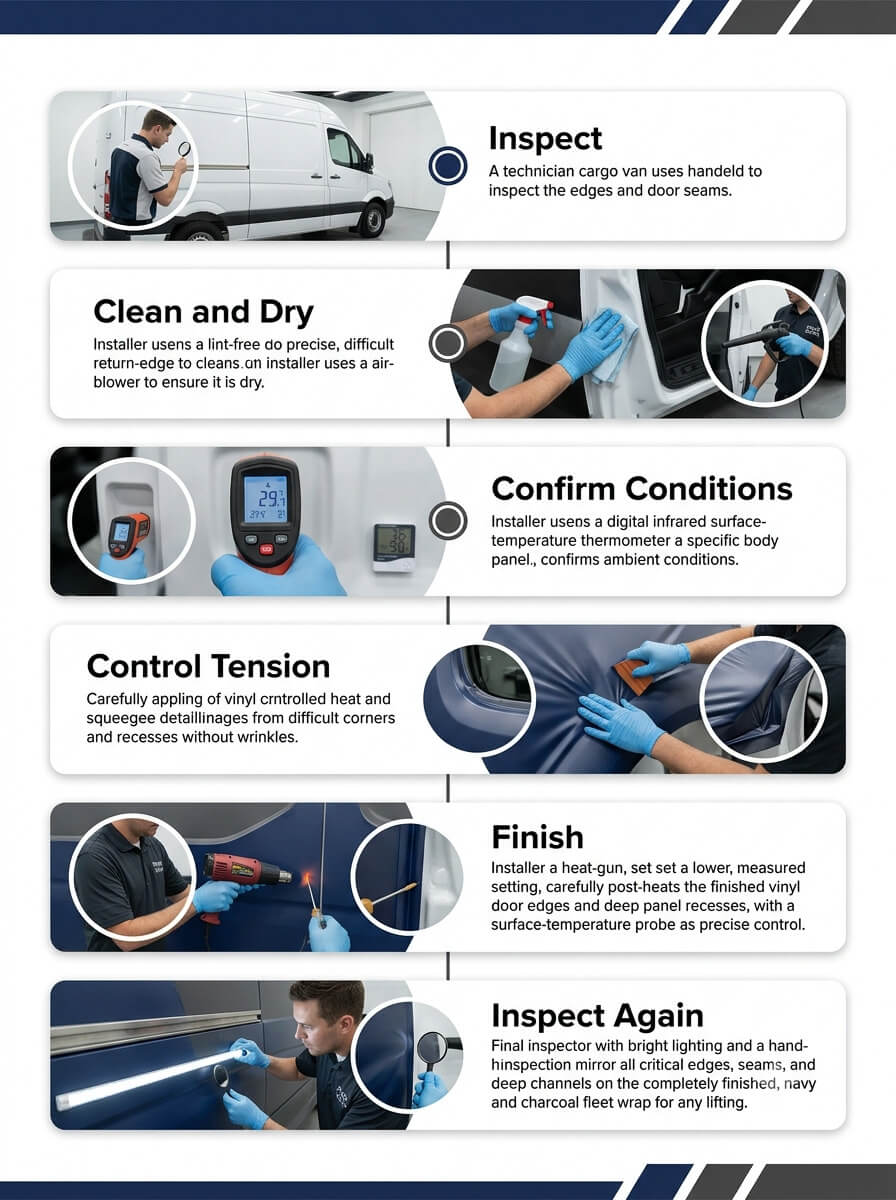
Our process is designed to reduce predictable lifting risks.
It includes:
- Inspecting the vehicle surface
- Confirming the wrap material
- Bringing the vehicle into a controlled environment
- Cleaning and drying visible and hidden areas
- Planning seams and termination points
- Managing film tension
- Using inlays where needed
- Cutting moving body gaps
- Applying product-specific heat
- Resqueegeeing edges and overlaps
- Completing a final inspection
- Holding the vehicle indoors when required
- Providing care instructions
- Evaluating reported concerns promptly
No installation process can prevent collision damage, failing paint, or misuse. It can reduce avoidable lifting caused by incorrect preparation, material selection, paneling, and finishing.
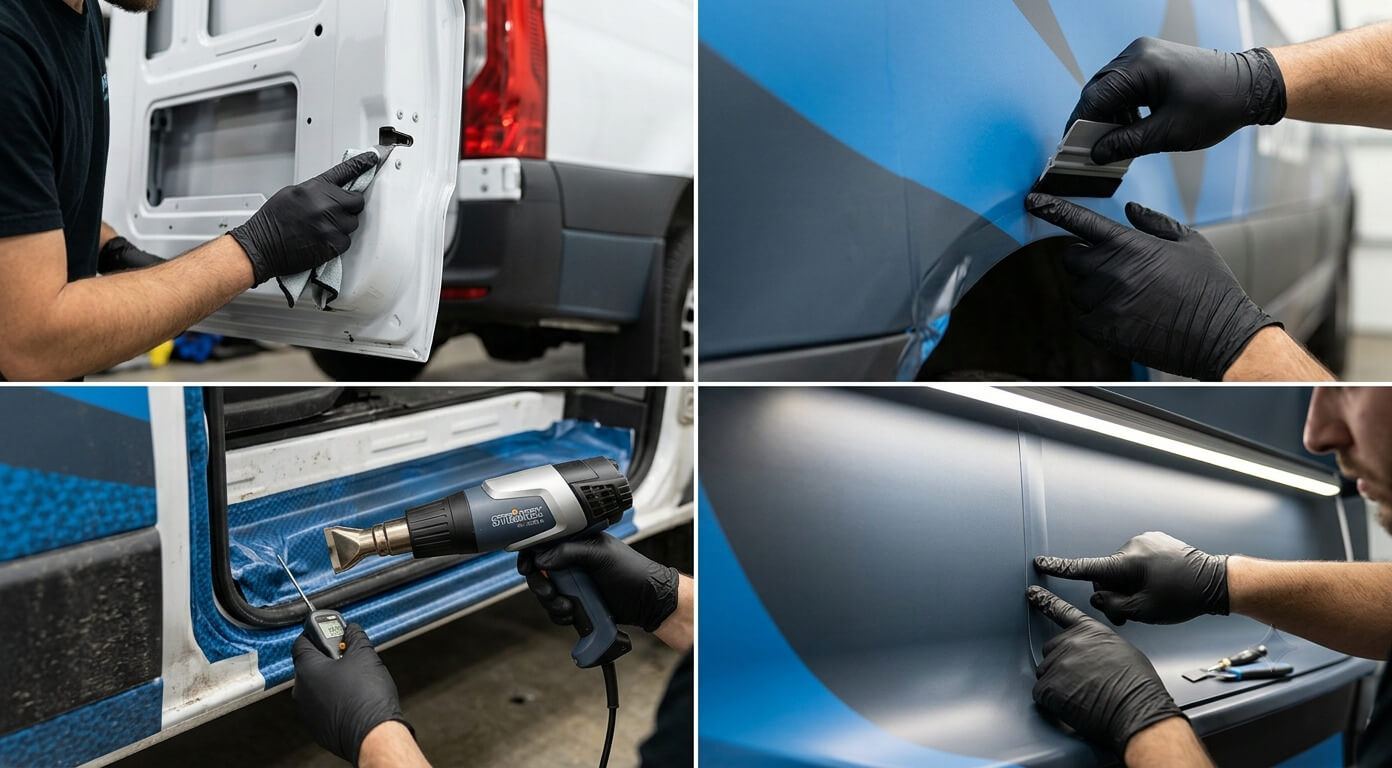
Address Small Edge Problems Early
Vehicle-wrap edges are exposed to some of the most demanding conditions on the vehicle.
Preventing lifting requires:
- A suitable material
- A stable surface
- Complete cleaning and drying
- Controlled installation temperature
- Correct pressure
- Managed stretch
- Product-specific post-heating
- Proper panel and overlap placement
- Careful washing
- Prompt repairs
A lifted edge does not automatically identify the cause. It should be inspected before someone attempts a quick fix.
Ask Pixel Wraps to Inspect Your Vehicle Graphics
If you notice lifting, take photographs and contact Pixel Wraps before washing, trimming, heating, or gluing the area.
Our team can review:
- The location
- Vehicle surface
- Material
- Installation history
- Physical damage
- Maintenance
- Surrounding panel condition
We can then recommend a targeted repair, panel replacement, or broader wrap update based on the actual condition.