“Certified installer” is one of the most frequently used phrases in the vehicle-wrap industry—and one of the most easily misunderstood.
A certification can indicate that an individual installer passed a hands-on and written assessment for a specific manufacturer or application category. In other programs, certification applies to the installation company and includes business-practice requirements in addition to technical testing.
Certification is valuable, but it is not a universal guarantee covering every employee, material, vehicle, or installation.
At Pixel Wraps, we believe businesses should understand which credential a provider holds, who earned it, what applications it covers, and who will actually install the graphics.
This guide explains common vehicle-wrap credentials and what fleet owners should verify before selecting an installation provider.
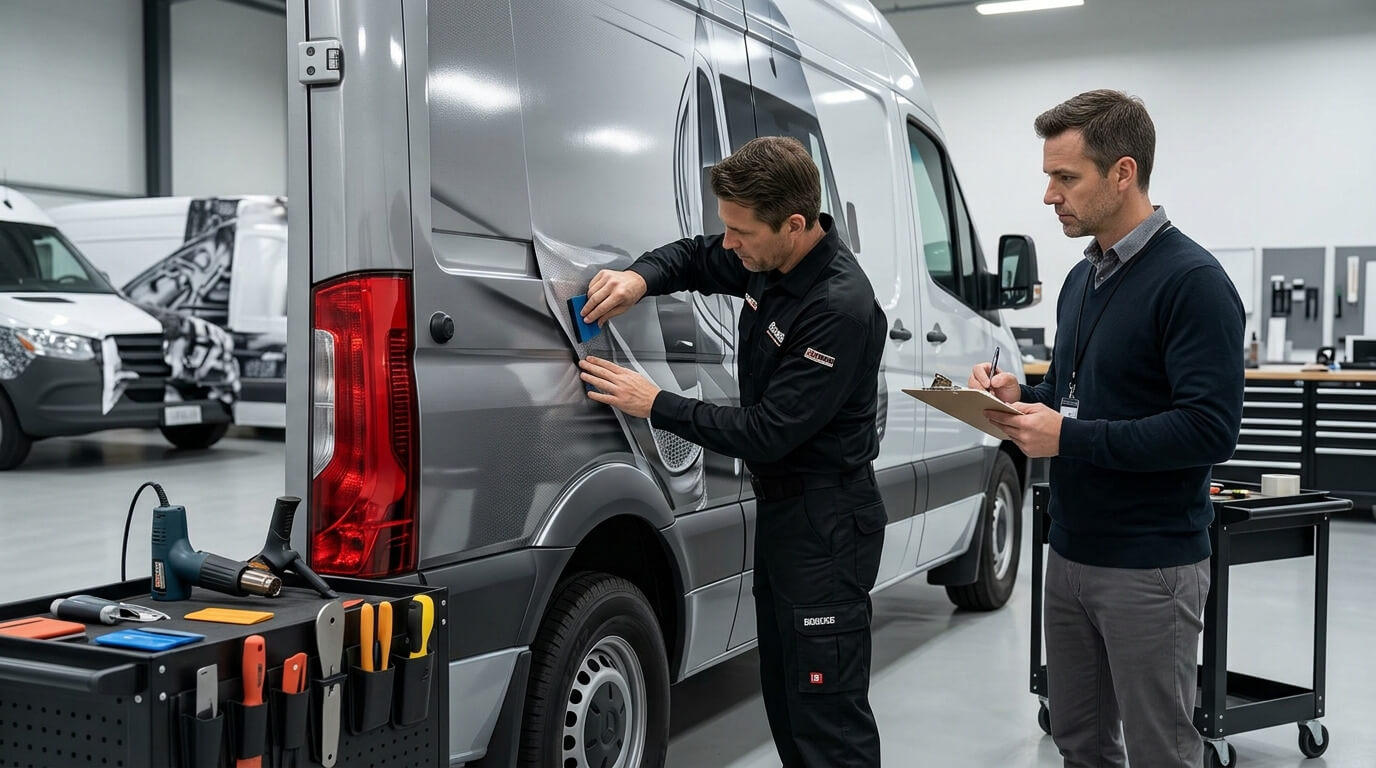
Certification Can Apply to a Person or a Company
One of the first questions to ask is:
Who is certified?
The answer may be:
- An individual installer
- The installation company
- One employee working for the company
- A subcontractor hired for selected projects
- A person who previously worked at the company
- A team member certified for a different application category
These situations are not equivalent.
Individual Certification
An individual credential belongs to the installer who completed the required testing.
If that person leaves the business, the credential generally leaves with them.
A company should not imply that every installer is individually certified merely because one member of its team earned a credential.
Company Certification
A company-level credential may include requirements involving:
- Qualified employees
- Installation testing
- Business history
- Insurance
- Professional conduct
- References
- Facility or process reviews
- Continuing program compliance
The exact requirements depend on the certification program.
A company credential still does not mean every technician has passed the same individual examination. It indicates that the organization meets the applicable program standards and maintains the required qualified personnel.
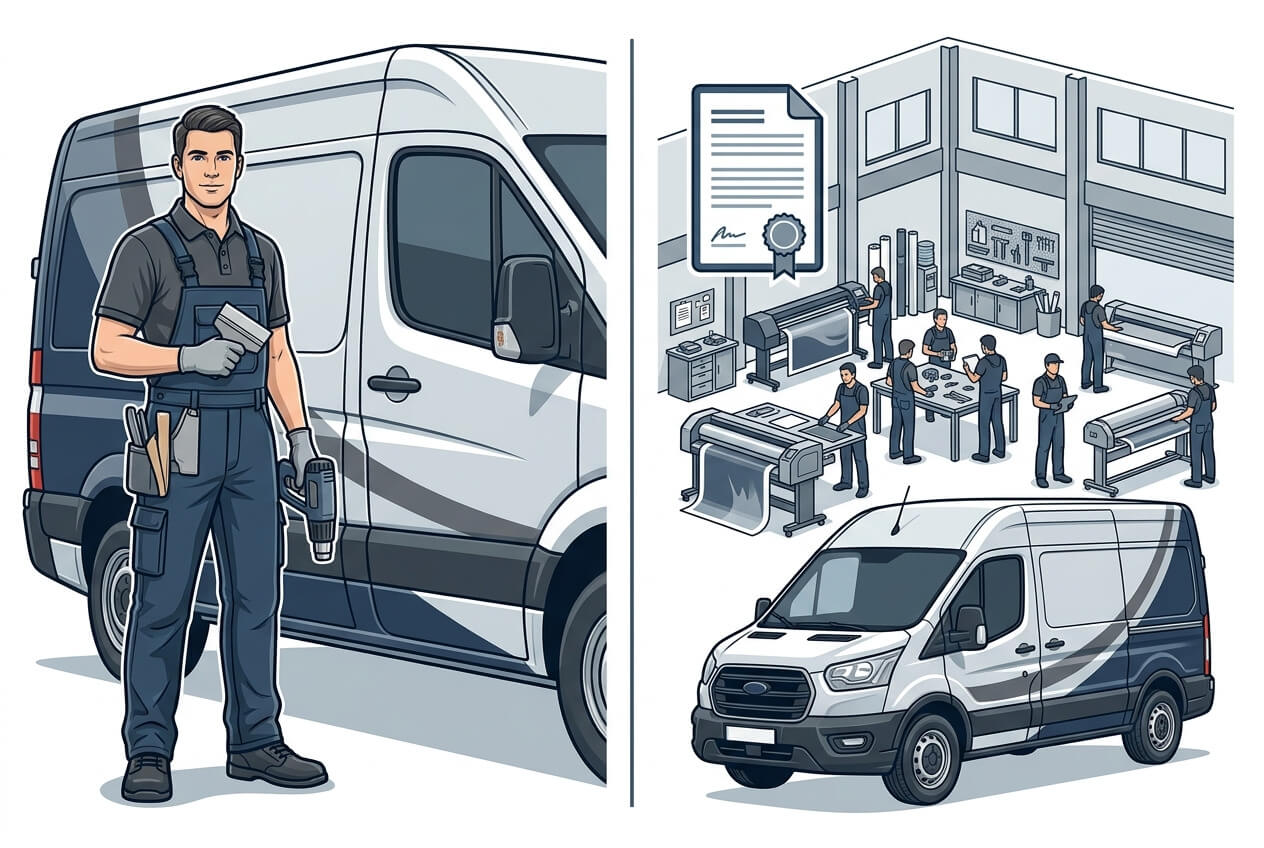
What Is a 3M Preferred Installer?
3M’s current installer information describes a 3M Preferred Installer as an individual who has passed advanced testing for the applicable installation specialty.
Specialties can include areas such as:
- Fleet graphics
- Vehicle color change
- Windows, walls, and floors
- Architectural finishes
The specialty matters.
An installer tested for one type of application should not automatically be described as tested for every other category.
3M’s official training FAQ also distinguishes the individual Preferred Installer credential from the Certified Graphics Installation Company designation.
See the 3M Find an Installer page and 3M Installer Training FAQ.
What Is a 3M Certified Graphics Installation Company?
The 3M Certified Graphics Installation Company program applies to companies rather than only individuals.
The program is administered with the United Application Standards Group, commonly called UASG.
According to current 3M and UASG information, the company designation involves qualified installation personnel as well as professional business requirements.
UASG describes participating companies as being evaluated through requirements that can include:
- Hands-on testing
- Written testing
- Established business history
- Professional business practices
- References
- Insurance
- Code-of-conduct obligations
- Continuing program compliance
See the UASG program overview and UASG membership requirements.
3M’s current training comparison guide provides additional distinctions between individual Preferred Installer status and Certified Graphics Installation Company status.
See the 3M Films Training Classes and Testing Guide.
A business should confirm the company’s current listing rather than relying only on an old logo displayed on a website or vehicle.
What Is an Avery Dennison Certified Wrap Installer?
Avery Dennison offers an individual Certified Wrap Installer credential, commonly referred to as CWI.
Avery’s current certification information recommends substantial hands-on experience before attempting the certification exam. The assessment is intended to evaluate practical vehicle-wrap installation skills rather than only course attendance.
See the Avery Dennison CWI Certification Exam page.
Avery Dennison also offers training programs at different skill levels. Training and certification are related, but they are not identical.
A person may:
- Attend a training course without taking the certification exam
- Complete training but not pass certification testing
- Pursue certification based on prior experience
- Hold a credential for an individual while working for a noncertified company
Fleet owners should ask whether the installer attended training or passed the formal certification assessment.
Training Is Not Automatically Certification
Professional training is valuable even when it does not lead to a formal credential.
Training can teach:
- Material selection
- Surface preparation
- Panel planning
- Squeegee technique
- Heat management
- Cutting
- Edge finishing
- Channel installation
- Removal
- Problem diagnosis
However, phrases such as the following are not interchangeable:
- Manufacturer-trained
- Course attendee
- Certificate of completion
- Preferred installer
- Certified wrap installer
- Certified installation company
A certificate showing that someone attended a class may not indicate that the person passed a hands-on proficiency test.
A provider should describe its qualifications accurately.
Certification Is Usually Application-Specific
Vehicle-wrap installation includes multiple specialties.
An installer may be experienced in:
- Printed commercial fleet graphics
- Solid-color change wraps
- Box trucks and trailers
- Riveted surfaces
- Transit graphics
- Reflective graphics
- Perforated window film
- Paint protection film
- Architectural graphics
These applications require overlapping skills, but they are not identical.
For a commercial fleet project, the most relevant experience includes:
- Large printed panel alignment
- Multi-vehicle consistency
- Commercial van channels
- Door hardware and body seams
- Fleet documentation
- Repair and replacement planning
- Manufacturer-specific film systems
A color-change portfolio filled with sports cars does not automatically demonstrate experience managing fifty printed service vans.
The certification specialty and the provider’s actual project history should both fit the work.
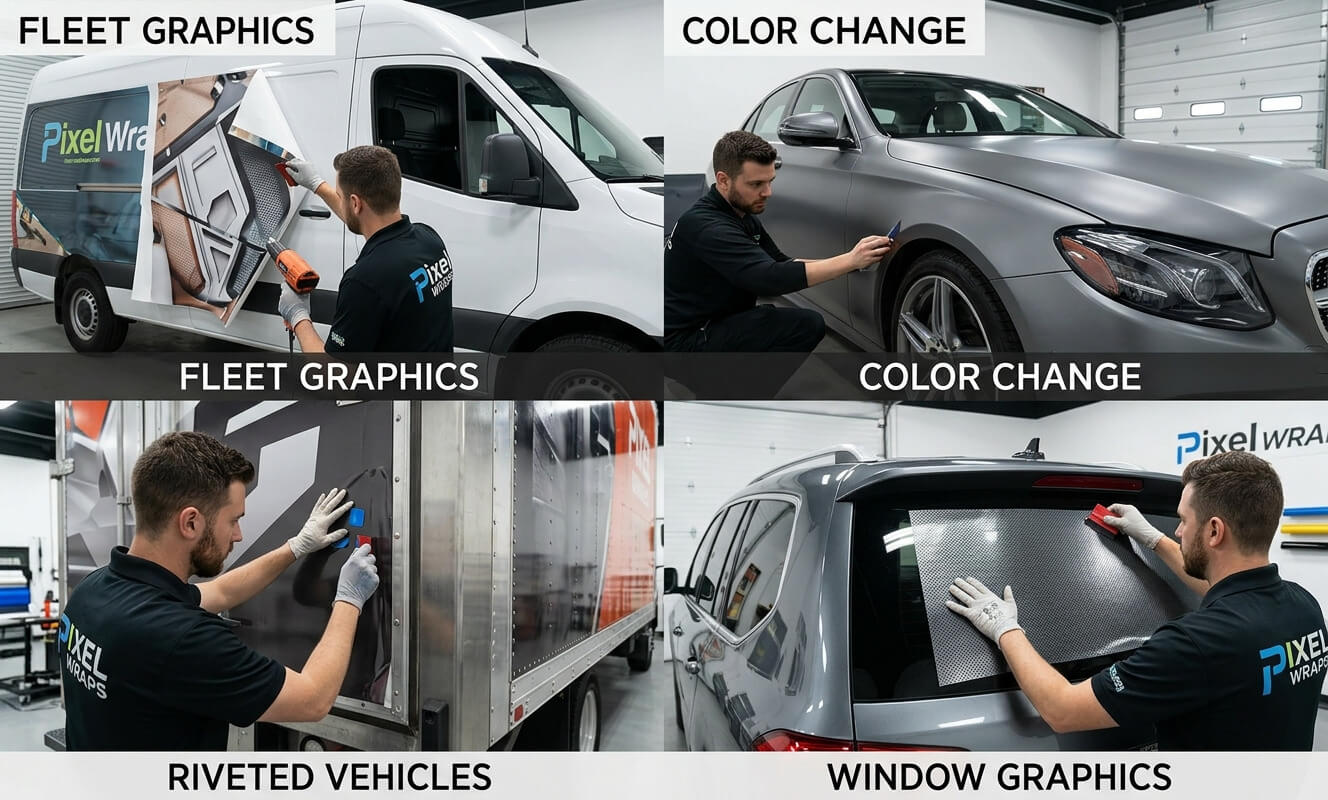
What Does Certification Testing Evaluate?
Programs differ, but hands-on vehicle-wrap assessments may evaluate skills such as:
- Surface preparation
- Material handling
- Panel positioning
- Squeegee technique
- Heat use
- Film stretching
- Cutting
- Trimming
- Edge finishing
- Seams and overlaps
- Complex curves
- Recesses
- Problem correction
- Work speed
- Safety
- Written technical knowledge
Avery Dennison’s published certification information has described practical modules involving vehicle panels, cutting, and a written examination.
3M’s current training materials similarly identify testing for specific installation categories.
The purpose is to show that the installer can perform defined tasks under assessment conditions.
Passing a test does not mean the person will never make a mistake. It provides evidence that the installer demonstrated a recognized level of knowledge and skill.
What Certification Does Not Guarantee
Certification should be considered one useful qualification—not an unlimited promise.
It Does Not Guarantee the Vehicle’s Paint
An installer cannot control weak factory paint, poor repainting, failing clear coat, rust, or previous collision repairs.
The vehicle must still be inspected before installation.
It Does Not Guarantee Every Material Is Appropriate
A trained installer must still select a film suitable for the surface, body shape, service period, and environment.
Certification cannot make general-purpose sign vinyl behave like premium cast wrap film.
It Does Not Guarantee the Design Is Effective
The installation can be technically correct while the graphic remains difficult to read or poorly adapted to the vehicle.
Design and installation are separate professional disciplines that need to work together.
It Does Not Guarantee Print Quality
Banding, incorrect color, low-resolution artwork, or improperly processed ink originate before installation.
The production system must be controlled as carefully as the application.
It Does Not Automatically Create Manufacturer Warranty Coverage
Manufacturer warranty eligibility may depend on:
- Exact film
- Laminate
- Ink
- Printer
- Exposure
- Application
- Documentation
- Processing
- Installation requirements
A certified installer is one part of the system. Certification alone does not make an unapproved material combination eligible.
It Does Not Mean Every Employee Is Certified
The business should identify who holds the credential and who will perform or supervise the work.
Certification and Workmanship Warranties Are Different
An installer credential verifies that a person or company met a program’s requirements.
A workmanship warranty is a separate written commitment from the wrap provider.
It may address qualifying issues such as:
- Edge lifting related to installation
- Panel alignment
- Contamination introduced during application
- Installation-related seam problems
- Other defined workmanship concerns
The workmanship terms should explain:
- Coverage period
- Exclusions
- Reporting process
- Inspection requirements
- Repair procedure
- Available remedy
Neither certification nor workmanship coverage should be assumed from the other.
Certification and Insurance Are Also Different
A technically skilled installer should still operate with suitable business protections.
Commercial fleet owners may need to verify:
- General liability insurance
- Garage keepers or applicable vehicle-custody coverage
- Workers’ compensation where required
- Written project agreement
- Vehicle check-in documentation
- Damage-reporting procedure
- Subcontractor responsibility
A manufacturer credential does not replace insurance.
Company-level certification programs may consider business practices, but the customer should still request current project-specific information when necessary.
Verify That the Credential Is Current
Certification programs, titles, and requirements can change.
An installer may have:
- Earned a credential years ago
- Allowed it to lapse
- Changed employers
- Been certified for a different specialty
- Left the company
- Displayed an outdated badge
Fleet owners can verify credentials through the applicable manufacturer or program directory when available.
3M provides an installer locator that distinguishes Preferred Installers from Certified Graphics Installation Companies and identifies applicable specialties.
Avery Dennison also provides certification and installer resources through its graphics website.
Verification is especially important for large fleet programs, national installations, or projects where a particular credential is required by procurement.
Ask Who Will Actually Install the Vehicles
A sales representative may accurately state that the company works with certified installers, but that does not explain who will be assigned to the project.
Ask:
- Is the credential held by the company or an individual?
- Who is the credential holder?
- What specialty does it cover?
- Will that person install the vehicle?
- Will they supervise the team?
- Are temporary labor or subcontractors involved?
- How are additional installers trained?
- Who performs final inspection?
Large fleet projects often require more than one installer.
That is not automatically a problem. The provider should have a clear system for supervision, panel standards, finishing, and quality control across the team.
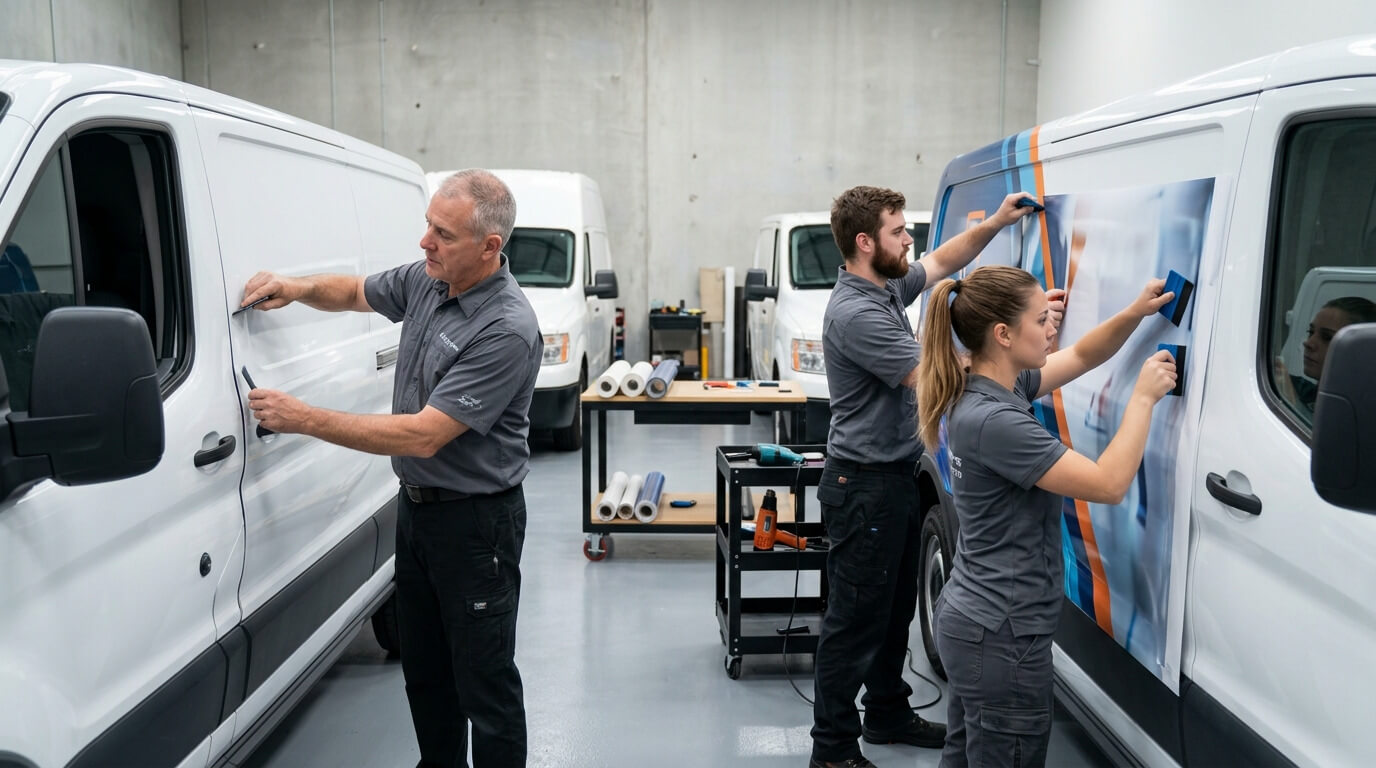
Certification Should Be Supported by Relevant Experience
A credential becomes more meaningful when it is supported by actual commercial fleet work.
Ask to see examples involving:
- Similar vehicle models
- Similar graphic coverage
- Comparable fleet size
- Complex channels or contours
- Box trucks or trailers if relevant
- Multiple vehicles produced consistently
- Repairs or fleet additions
- Projects installed several years earlier
Fresh installation photographs show appearance on delivery day. Older project photographs or repeat-client work can provide additional context about production consistency and service.
References may also be appropriate for large contracts.
Facility and Process Still Matter
Even a highly skilled installer needs suitable working conditions.
A professional fleet-wrap operation should consider:
- Climate-controlled installation
- Clean work areas
- Suitable lighting
- Vehicle access
- Surface preparation
- Material storage
- Production quality
- Panel organization
- Post-heating tools
- Final inspection
- Documentation
Certification cannot compensate for wrapping a cold, wet, contaminated vehicle outdoors.
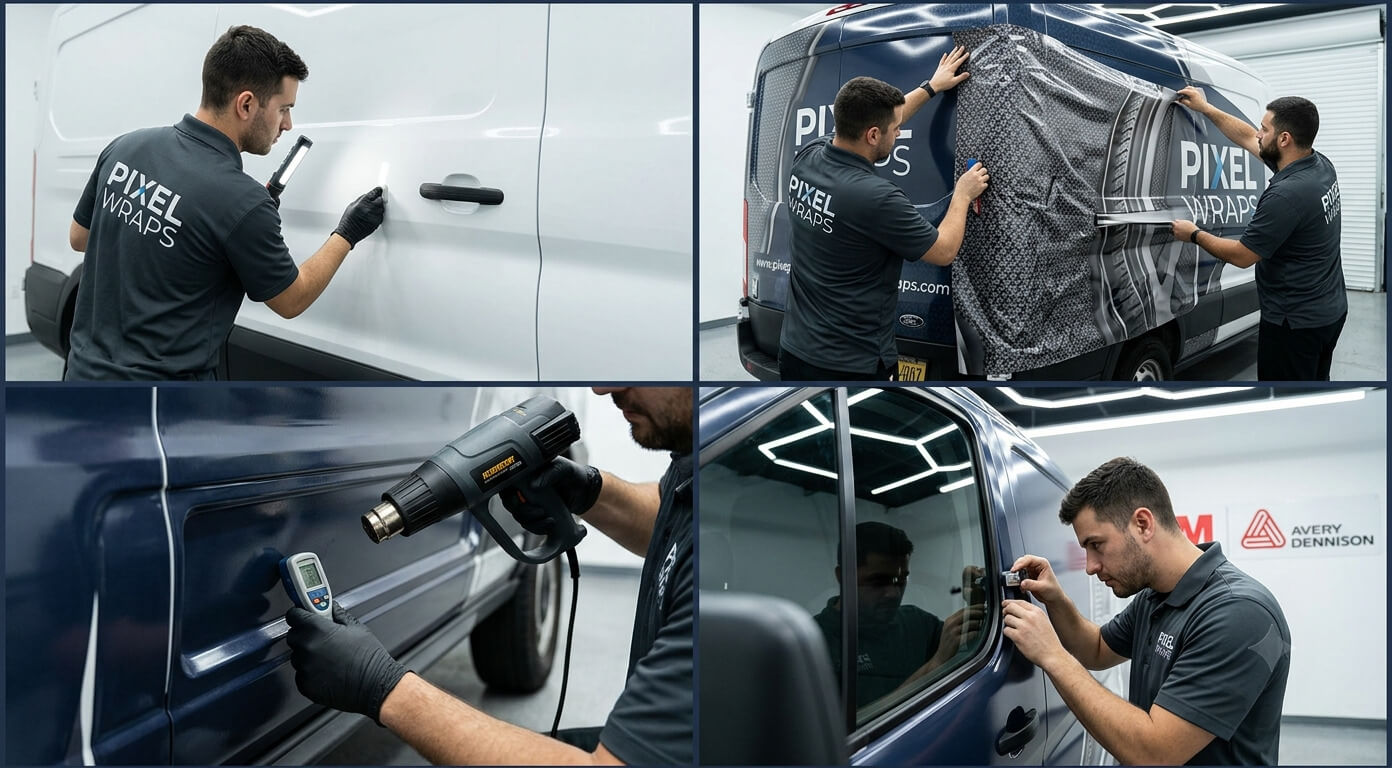
Pixel Wraps combines trained installation practices with in-house design, printing, lamination, and a controlled installation environment. That allows potential production or design issues to be addressed before they reach the vehicle.
Questions to Ask About Installer Certification
| Question | What the answer should clarify |
| What is the exact credential name? | Avoids vague “certified” claims |
| Does it apply to an individual or the company? | Identifies who owns the qualification |
| Which manufacturer or organization issued it? | Allows independent verification |
| What application specialty does it cover? | Confirms relevance to commercial fleet work |
| Is the credential current? | Outdated qualifications may no longer be listed |
| Who will install or supervise my vehicles? | Connects the credential to the actual project team |
| Is installation completed in-house? | Identifies subcontracting and responsibility |
| What similar fleet projects have you completed? | Certification should be supported by relevant experience |
| What workmanship coverage is provided? | Credential and project warranty are separate |
| What material system will be installed? | Correct vinyl and laminate still matter |
| Is the facility climate-controlled? | Stable conditions support professional installation |
| How is the finished wrap inspected? | Quality control should continue after application |
How Pixel Wraps Approaches Installation Quality
Our installation process is built around more than one credential.
It includes:
- Selecting the correct material system
- Reviewing vehicle condition
- Producing graphics in-house
- Processing and laminating the print correctly
- Acclimating and preparing the vehicle
- Planning seams, overlaps, and panels
- Installing in a controlled environment
- Using trained professional techniques
- Inspecting channels, edges, seams, and hardware
- Documenting materials and the completed project
- Providing care instructions
- Addressing reported issues based on their actual cause
Pixel Wraps’ team has experience with professional manufacturer systems and certified installation practices. For projects requiring a particular credential or manufacturer program, customers should identify that requirement during the proposal stage so the exact qualification and system can be confirmed.
Certification Is Evidence—Not the Entire Decision
A recognized installer certification can show that an individual or company completed defined testing and program requirements.
That is meaningful, but fleet owners should also evaluate:
- Relevant commercial experience
- Current credential status
- Who will perform the work
- Material selection
- Production quality
- Installation facility
- Insurance
- Workmanship terms
- Quality-control process
- Long-term support
The strongest provider is not simply the company displaying the most badges. It is the company that can accurately explain its qualifications and connect them to a controlled, documented project process.
Discuss Your Fleet Installation With Pixel Wraps
If your company requires certified installation, an approved manufacturer system, or installation across multiple vehicle types, include those requirements when requesting a quote.
Pixel Wraps can review:
- Vehicle types
- Fleet quantity
- Material specifications
- Installation schedule
- Credential requirements
- Warranty requirements
- Facility and delivery logistics
Contact our team to discuss your commercial vehicle-wrap installation and receive a project plan based on the actual fleet.