Not every commercial vehicle graphic needs to remain in place for several years.
Some businesses need permanent fleet branding. Others need graphics for a product launch, seasonal promotion, event, temporary route, political campaign, or limited sponsorship.
The expected service period should be established before the material is selected.
A short-term wrap is not simply a long-term wrap removed early. It may use a different film construction, adhesive, laminate, installation method, and removal plan. At the same time, a material advertised for promotional graphics is not necessarily removable from vehicle paint.
At Pixel Wraps, we consider the campaign timeline, vehicle surface, graphic coverage, body shape, exposure, and removal requirements before specifying a system.
This guide explains the practical differences between short-term and long-term commercial vehicle-wrap materials.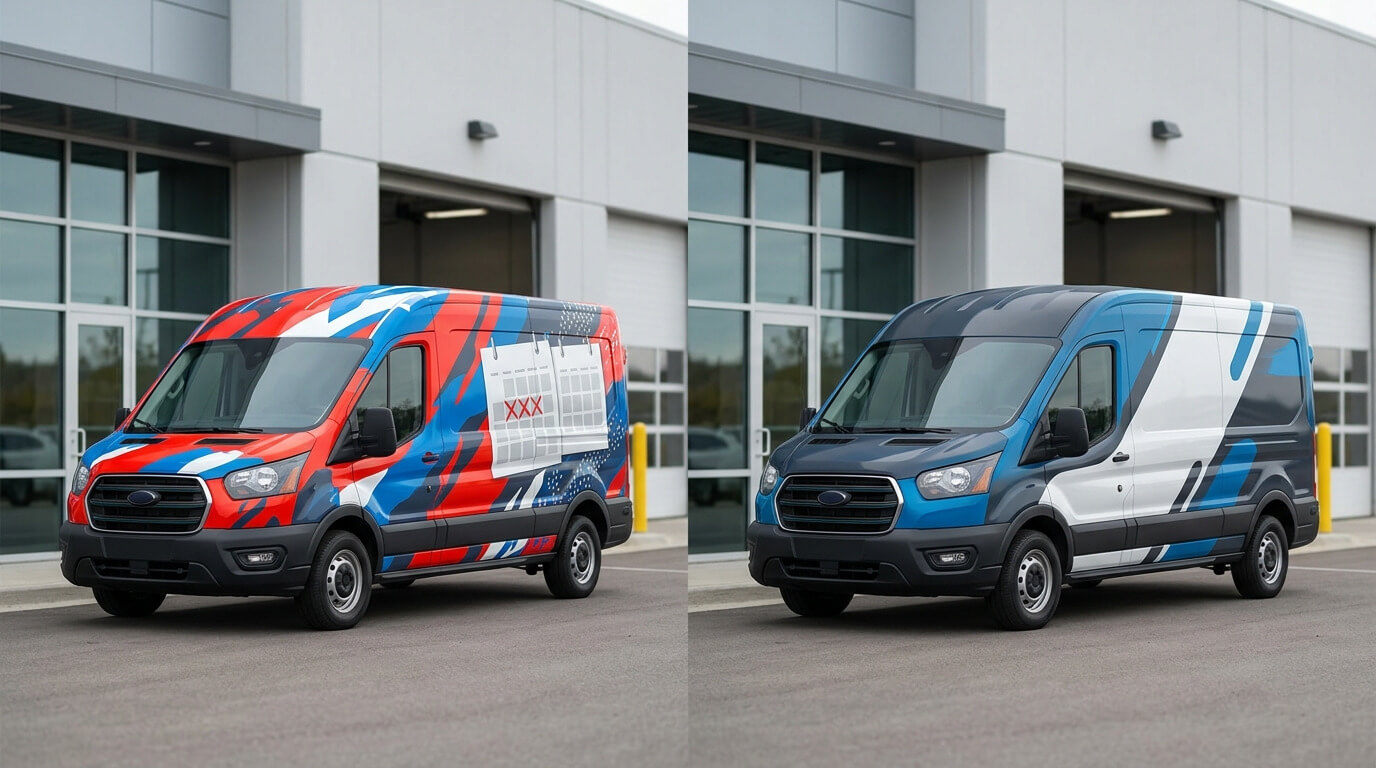
What Is a Short-Term Vehicle Wrap?
A short-term vehicle wrap or graphic is produced for a defined, limited campaign.
Common applications include:
- Seasonal promotions
- Product launches
- Trade shows
- Sporting events
- Festivals
- Temporary sponsorships
- Grand openings
- Political campaigns
- Limited-time offers
- Movie, television, or production vehicles
- Temporary transit advertising
- Short-term fleet rebranding during a merger or rollout
The campaign might last a few days, several months, or approximately one year. There is no single industry duration that makes every graphic “short term.”
For Pixel Wraps, the important point is that the planned removal date is known before production.
That date helps us evaluate whether the project requires:
- A removable adhesive
- A permanent adhesive
- A cast or calendared face film
- Full or partial coverage
- A protective laminate
- Simple-curve or complex-curve conformability
- Special removal procedures
Short term describes the campaign. It does not automatically describe the adhesive.
What Is a Long-Term Vehicle Wrap?
A long-term commercial wrap is intended to serve as continuing fleet branding rather than a limited promotion.
Common applications include:
- Plumbing and HVAC fleets
- Electrical contractor vans
- Delivery vehicles
- Construction trucks
- Food-service vehicles
- Corporate fleets
- Franchise vehicles
- Box trucks
- Trailers
- Service pickups
- Municipal and institutional vehicles
These projects typically place more emphasis on dimensional stability, conformability, long-term appearance, compatible laminates, edge performance, and future repair consistency.
Professional long-term printable systems can include products such as:
- 3M Print Wrap Film IJ280
- 3M Controltac Graphic Film IJ180mC
- Avery Dennison MPI 1105 Easy Apply RS
- General Formulations GF 830 AutoMark
- ORAFOL ORAJET 3951RA
These are examples—not interchangeable recommendations. Every product’s current technical data must be checked against the exact vehicle and application.
Campaign Length and Material Durability Are Not the Same Thing
Several different timelines may appear in a product data sheet:
Outdoor Durability
This is an estimate of how long an unprocessed film may perform under defined conditions. It may assume a vertical, flat outdoor surface and does not necessarily represent a printed wrap on every part of a vehicle.
Expected Performance Life
Some manufacturers use this term for an estimated period rather than a formal warranty. Conditions and exclusions still apply.
Warranty Period
A warranty is governed by specific terms. It may depend on approved films, inks, printers, laminates, exposure zones, orientations, surfaces, and applications.
Removability Period
This indicates the period during which the manufacturer expects the adhesive to meet defined removal characteristics from an approved surface under stated conditions.
These numbers should not be treated as identical.
A film might have several years of outdoor durability but only a shorter stated removability period. Another product may be promoted for short-term graphics while using a permanent adhesive.
That is why we read the complete technical data sheet instead of selecting material from one durability number.

Removable Adhesive vs. Permanent Adhesive
This is one of the most important distinctions in temporary vehicle graphics.
Removable Adhesive
A removable adhesive is formulated to allow removal from approved surfaces within stated conditions and time limits.
Its performance still depends on:
- Surface type
- Paint condition
- Application temperature
- Length of service
- Sun and heat exposure
- Graphic orientation
- Removal temperature
- Removal method
- Whether the surface was repainted
- Whether the material was applied over existing graphics
The word “removable” does not guarantee damage-free removal from every vehicle.
Permanent Adhesive
Permanent adhesive is designed to establish a strong continuing bond. It may be appropriate for long-term graphics, but some economical promotional films also use permanent adhesive.
Permanent films can often be physically removed with professional tools and heat. However, removal may be slower, leave more residue, or create additional risk on questionable paint.
A temporary campaign with a known removal date should not automatically use permanent adhesive simply because the film is inexpensive.
High-Tack Permanent Adhesive
High-tack permanent products are manufactured for difficult surfaces such as certain plastics, powder-coated metals, or other hard-to-stick substrates.
They are not general-purpose temporary vehicle films.
For example, General Formulations GF 203HTAP uses a high-tack permanent adhesive. Its official technical data describes applications such as demanding signage and hard-to-stick surfaces—not short-term graphics on normal painted vehicle panels.
Using an aggressive permanent adhesive where clean removal is important can create unnecessary labor, adhesive residue, or surface risk.
See the GF 203HTAP Technical Data Sheet.
An Important Note About 3M IJ35C
3M IJ35C is sometimes considered for economical promotional graphics on suitable flat, smooth surfaces. However, it should not be described as a removable vehicle-wrap film.
According to 3M’s current product information, IJ35C is a calendared film with a permanent pressure-sensitive adhesive. The IJ35C versions include Comply air-release channels, but air release affects installation—not removability.
3M identifies the series for short- to long-term promotional graphics, signs, displays, exhibits, and similar applications. That description does not mean it is an ideal temporary wrap for every painted vehicle.
When we consider IJ35C, we evaluate:
- Whether the vehicle surface is approved
- Whether the graphic is on a flat or simple surface
- Whether permanent adhesive is acceptable
- Whether removal labor has been discussed
- Whether a more purpose-built removable film would be safer for the campaign
See the 3M IJ35/IJ35C Product Bulletin and the 3M IJ35C product page.
General Formulations GF 209 MetroMark for Temporary Graphics
GF 209 MetroMark is an example of a film developed specifically around temporary graphics and transit advertising.
The February 2026 General Formulations data sheet describes GF 209 as:
- A 3.5-mil polymeric vinyl
- High opacity
- Suitable for temporary applications
- Equipped with removable acrylic adhesive
- Suitable for simple curves
- Intended for applications including transportation advertising
The same data sheet identifies a one-year removability period under the manufacturer’s conditions. That should not be confused with the film’s separate published outdoor-durability figure.
GF 209 is not listed for complex-curve wrapping. It may suit flat and simple-curved vehicle areas, transit panels, or temporary layered advertising, but it should not be forced into deep cargo-van channels.
GF 209AE adds an air-egress liner intended to make installation easier while retaining the temporary transit-graphic purpose.
See the current GF 209 MetroMark Technical Data Sheet and GF 209AE Technical Data Sheet.
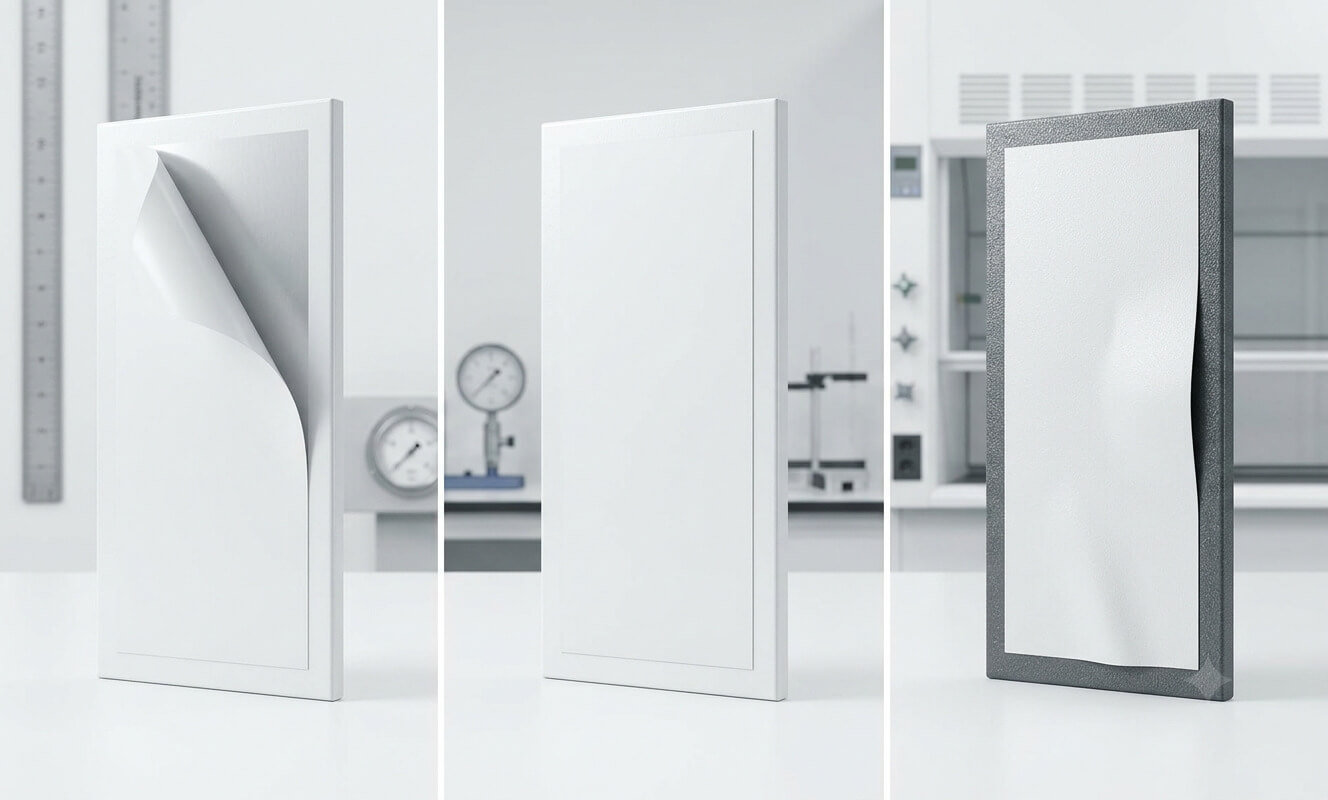
Short-Term Materials Usually Have Different Limits
A temporary film can reduce material cost, but that does not mean it can perform every task of a premium cast wrap film.
Short-term promotional films may be limited to:
- Flat surfaces
- Simple curves
- Vertical exposure
- Shorter removability windows
- Specific temperature ranges
- Limited vehicle types
- Particular printing systems
- Reduced conformability
- Less demanding washing conditions
A film that works across a bus advertising panel may not work inside a deep recess on a cargo van.
When the temporary design requires complex coverage, we may need to adjust one of three things:
- Use a more conformable film that meets the removal requirement.
- Reduce the graphic coverage to avoid difficult areas.
- Redesign the panel layout with planned seams, inlays, or separate sections.
The lowest material cost is not useful if the film lifts before the campaign ends or requires excessive labor to remove.
Long-Term Materials Prioritize Stability and Conformability
Long-term commercial vehicle wraps often use premium cast printable films with matching cast overlaminates.
Depending on the product, these systems may provide:
- Better conformability over complex surfaces
- Greater dimensional stability
- Repositionable installation
- Air-release adhesive technology
- Long-term removable adhesive characteristics
- Approved manufacturer warranty systems
- Better suitability for full and partial wraps
- Options for consistent fleet production
For example, the current General Formulations GF 830 data sheet describes a cast printable film with a slidable and repositionable adhesive system, air egress, and long-term removable adhesive characteristics.
See the GF 830 AutoMark Technical Data Sheet.
Similarly, 3M IJ280 and Avery Dennison MPI 1105 are positioned as professional printable systems for demanding vehicle and fleet applications.
A long-term film still requires professional surface preparation, compatible laminate, correct installation, and proper maintenance.
Cast vs. Calendared Material for Temporary Campaigns
It is tempting to assume that short-term always means calendared and long-term always means cast. The distinction is not that simple.
A Calendared Film May Work When:
- The graphics stay on flat panels
- The vehicle has simple curves
- The campaign has a defined removal date
- The product is approved for the surface
- The adhesive matches the removal plan
- The lower material cost produces a real project benefit
A Cast Film May Still Be Needed When:
- The temporary wrap covers deep channels
- The vehicle contains compound curves
- The design requires extensive coverage
- Dimensional stability is critical
- The film must conform without excessive tension
- A specific removable cast system is available for the application
Campaign duration does not change the vehicle’s body shape. A three-month full wrap on a complex van can still require a conformable material.
Do Short-Term Graphics Need Lamination?
Not every temporary graphic needs the same protection, but laminate should be considered before production.
The decision depends on:
- Campaign length
- Ink type
- Expected abrasion
- Cleaning frequency
- Road use
- Fuel or chemical exposure
- Required finish
- Whether the vehicle will be pressure washed
- Film-and-laminate compatibility
- Whether the added construction affects removal
General Formulations states that GF 209 does not necessarily require lamination but recommends compatible GF 100-series overlaminates when abrasion or cleaning chemicals justify additional protection.
For longer-term printed fleet graphics, a compatible overlaminate is generally a central part of the system.
We select the laminate with the print film instead of adding an arbitrary clear film after printing.
Vehicle Condition Matters for Both Categories
Neither temporary nor long-term wrap vinyl can guarantee safe removal from unstable paint.
Before installation, the vehicle should be evaluated for:
- Repainted panels
- Collision repairs
- Failing clear coat
- Rust or corrosion
- Rock chips
- Scratches
- Body filler
- Peeling factory graphics
- Existing adhesive residue
- Uncured paint
- Ceramic coatings, waxes, or surface treatments
A removable film can still pull weak paint away from the surface. A long-term removable adhesive can also become more difficult to remove when the graphic remains installed beyond the manufacturer’s specified conditions.
Pixel Wraps recommends documenting visible vehicle damage before installation and disclosing any known repainting or bodywork.
3M’s substrate-preparation bulletin explains that surface type, condition, cleaning, and preparation affect adhesion. See the 3M Substrate Selection and Preparation Bulletin.
Weather and Exposure Affect the Decision
Commercial vehicles in New Jersey, New York, and Pennsylvania encounter:
- Hot summer body-panel temperatures
- Freezing winter weather
- Snow and ice
- Road salt
- Rain
- Direct sunlight
- Tree residue
- Industrial contamination
- Frequent washing
A short-term campaign still needs a film capable of surviving its complete installation period.
A summer event wrap parked outside may receive substantial heat and UV exposure even if it remains installed for only a few months. A winter promotion may need to be installed at a controlled indoor temperature and then operate through salt, moisture, and freezing conditions.
We consider both the installation environment and the conditions the vehicle will face after leaving our facility.
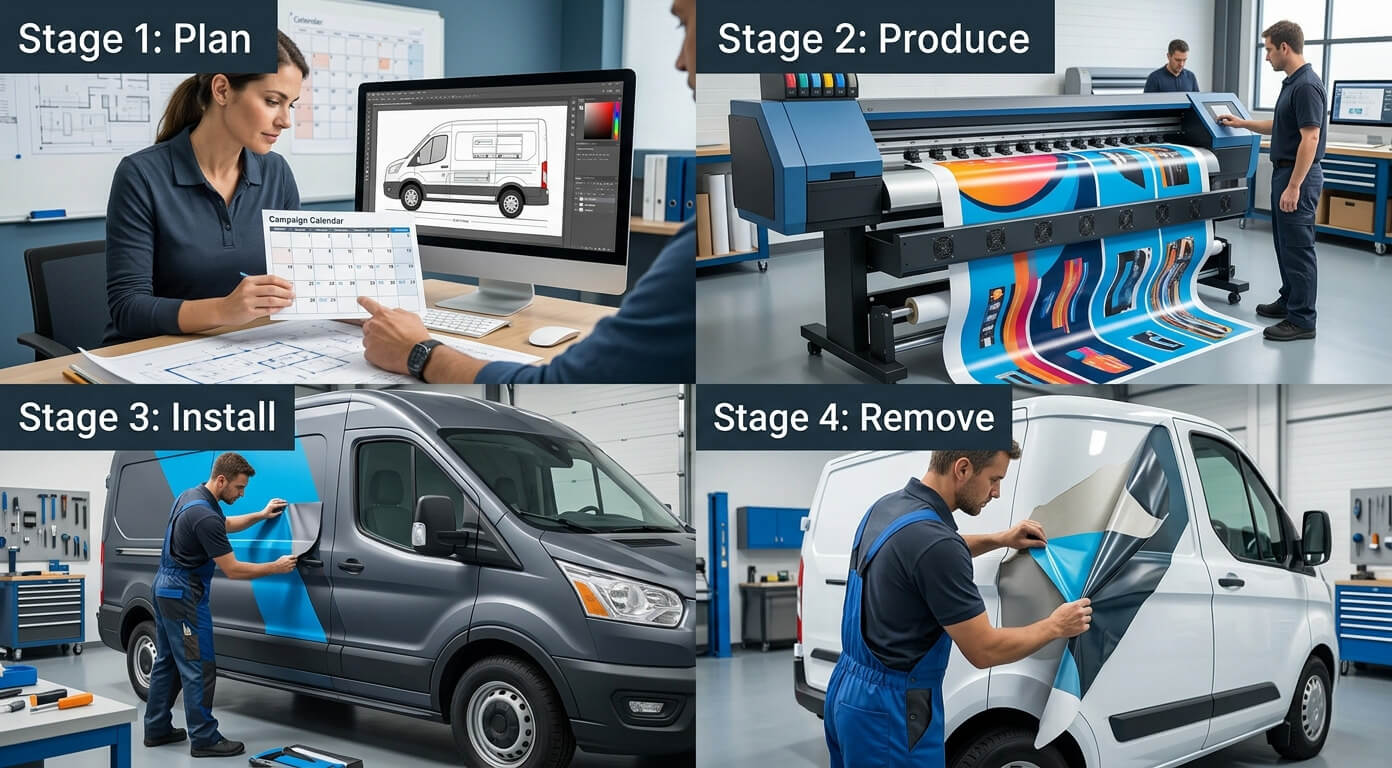
Removal Should Be Planned Before Installation
Removal is not an afterthought.
For a short-term project, the quote and production plan should address:
- Target removal date
- Manufacturer’s removability window
- Surface condition
- Whether graphics cover repainted panels
- Whether the film will be layered over existing vinyl
- Expected removal labor
- Possible adhesive residue
- Appropriate removal temperature
- Whether the vehicle must be returned immediately to service
Leaving temporary graphics installed beyond their intended period can make removal more difficult.
For long-term fleets, removal planning also matters. Businesses may rebrand, sell vehicles, return leased units, or replace damaged graphics before the wrap reaches the end of its possible service life.
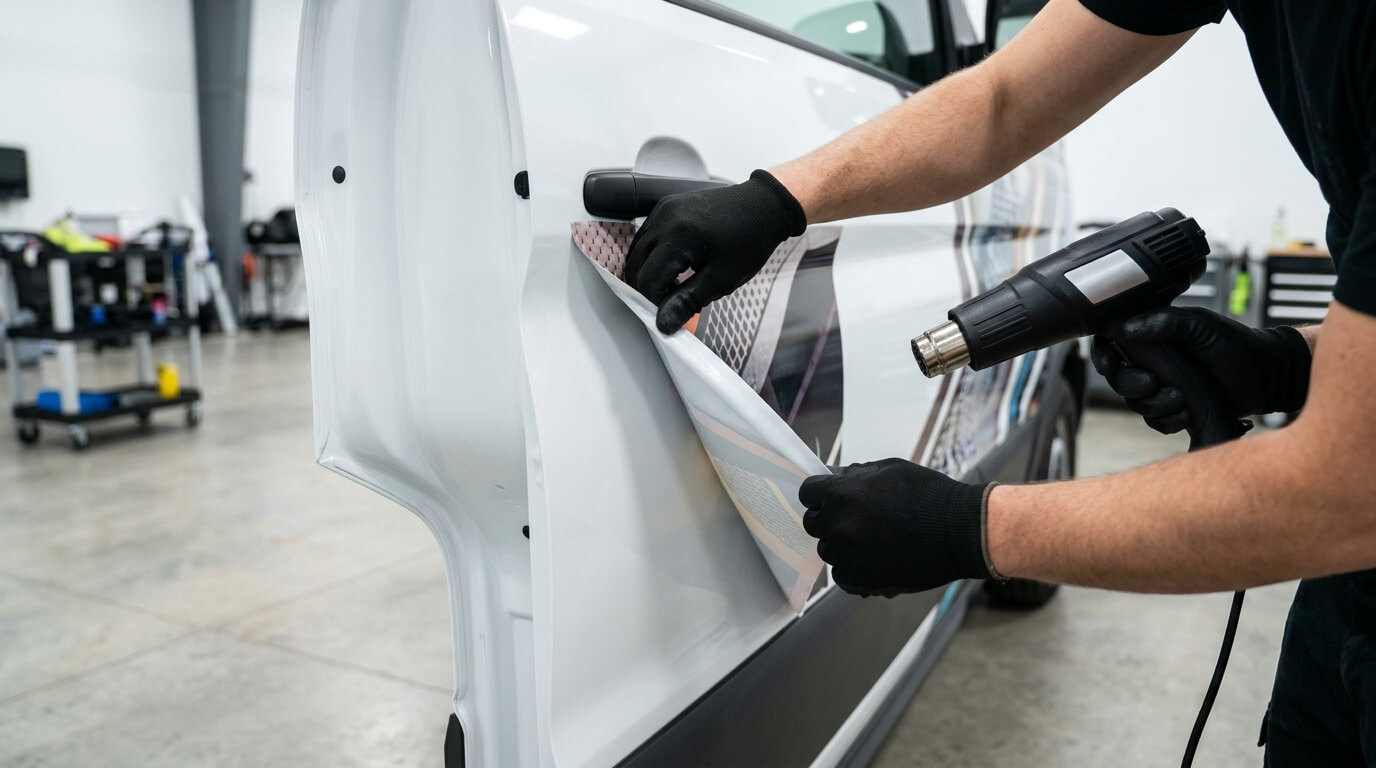
Professional removal generally uses controlled heat and appropriate technique. Excessive heat, harsh chemicals, or rushed pulling can damage surfaces and increase labor.
Short-Term vs. Long-Term Material Comparison
| Project factor | Short-term promotional system | Long-term fleet-wrap system |
| Primary purpose | Temporary campaign or limited promotion | Continuing company branding |
| Planned duration | Defined and relatively brief | Multiple operating seasons or ongoing fleet use |
| Typical coverage | Decals, panels, partial graphics, or selected full wraps | Partial or full commercial wraps |
| Film construction | Application-specific calendared, polymeric, or removable film | Frequently premium cast printable film |
| Adhesive | Often removable when clean removal is a priority | Commonly long-term removable or permanent, depending on system |
| Body complexity | Often best on flat or simple-curved surfaces unless a conformable system is selected | Premium systems can accommodate more complex contours when installed correctly |
| Lamination | Depends on abrasion, cleaning, ink, and campaign requirements | Normally specified as part of the complete printed system |
| Removal planning | Critical before production | Still necessary for rebranding, sale, lease return, or replacement |
| Cost priority | Avoid paying for unnecessary service life without creating removal problems | Balance initial cost with appearance, maintenance, and replacement frequency |
| Documentation | Campaign dates, material code, and removal deadline | Film, laminate, printer, color, production, and fleet-repair records |
Which System Is More Cost-Effective?
A short-term material can reduce project cost when the application genuinely fits its limits.
Possible savings may come from:
- Lower-cost face film
- Reduced coverage
- Simpler production
- A laminate selected only when needed
- Faster planned removal
- Avoiding unnecessary multi-year performance
However, a lower material price does not guarantee a lower total cost.
The business should consider:
- Installation labor
- Vehicle downtime
- Removal labor
- Adhesive cleanup
- Risk to questionable paint
- Replacement if the film lifts early
- Whether complex surfaces require a premium film
- Whether the graphics must remain presentable for the entire campaign
A long-term wrap usually costs more because it is designed and produced for more demanding service. For an active service fleet, that cost may be justified by continued advertising and fewer replacement cycles.
The correct comparison is total project cost over the required service period—not vinyl price per square foot.
When Pixel Wraps May Recommend a Short-Term System
We may recommend a temporary material when:
- The campaign has a firm removal date
- The graphics stay primarily on flat or simple-curved areas
- The approved removable adhesive fits the vehicle surface
- The customer expects a seasonal or event-based change
- A partial graphic can accomplish the marketing objective
- The removal plan is included from the beginning
GF 209 or GF 209AE may be considered for suitable temporary transportation graphics on approved surfaces and simple curves.
A product such as 3M IJ35C may be considered for selected economical promotional applications, but its permanent adhesive must be clearly accounted for. We would not present it as equivalent to a purpose-built removable transit film.
When Pixel Wraps May Recommend a Long-Term System
We may recommend a professional long-term wrap system when:
- The vehicle provides daily service for the same business
- The graphics must remain consistent across multiple years
- The body includes complex curves or channels
- Full-wrap coverage is required
- A matched manufacturer system is requested
- Fleet repairs and future additions must be supported
- The operating environment calls for stronger long-term performance
The final selection could come from 3M, Avery Dennison, General Formulations, ORAFOL, or another established manufacturer. We choose the complete construction around the job rather than specifying material by brand name alone.
Questions to Answer Before Requesting a Quote
Businesses can help a wrap provider recommend the right material by answering these questions:
- When will the graphics be installed?
- When should they be removed?
- Is the removal date firm or uncertain?
- Is this a full wrap, partial wrap, or set of decals?
- Does the vehicle have deep channels or compound curves?
- Has the vehicle been repainted or repaired?
- Will the graphics cover plastic, glass, or unusual surfaces?
- Will the vehicle be parked inside or outside?
- How will it be washed?
- Is the vehicle leased?
- Will another campaign be installed immediately afterward?
- Is clean removal more important than maximum bond strength?
The answers can materially change the film recommendation.
Choose the Material Around the Campaign
Short-term and long-term vehicle graphics can both be effective. They simply solve different business problems.
A temporary campaign should prioritize:
- A defined timeline
- Surface compatibility
- Appropriate adhesive
- Sufficient performance for the campaign
- Planned professional removal
A long-term fleet wrap should prioritize:
- Conformability
- Dimensional stability
- Complete film-and-laminate compatibility
- Long-term appearance
- Maintenance
- Repair and replacement records
Neither category should be reduced to “cheap vinyl” versus “premium vinyl.”
At Pixel Wraps, our in-house design, printing, lamination, and installation teams work from the same project requirements. That helps us match the visual campaign to the correct production and material strategy.
Plan Your Commercial Vehicle Campaign With Pixel Wraps
Whether your graphics need to last three months or several years, the material should be selected before the artwork moves into production.
Pixel Wraps can review your:
- Campaign timeline
- Vehicle condition
- Body style
- Graphic coverage
- Operating environment
- Maintenance practices
- Removal requirements
We can then recommend a short-term promotional system or a long-term commercial wrap construction based on the actual project.
Contact Pixel Wraps to discuss the campaign, vehicles, installation schedule, and expected removal date.