Vehicle-wrap vinyl is sensitive to the conditions in which it is installed.
The temperature of the air and vehicle surface can affect adhesive behavior, film flexibility, repositionability, and the installer’s ability to conform material around curves and channels. Moisture, condensation, wind, and dust can create additional problems.
This is why professional commercial vehicle wraps should be installed indoors in a clean, climate-controlled space whenever possible.
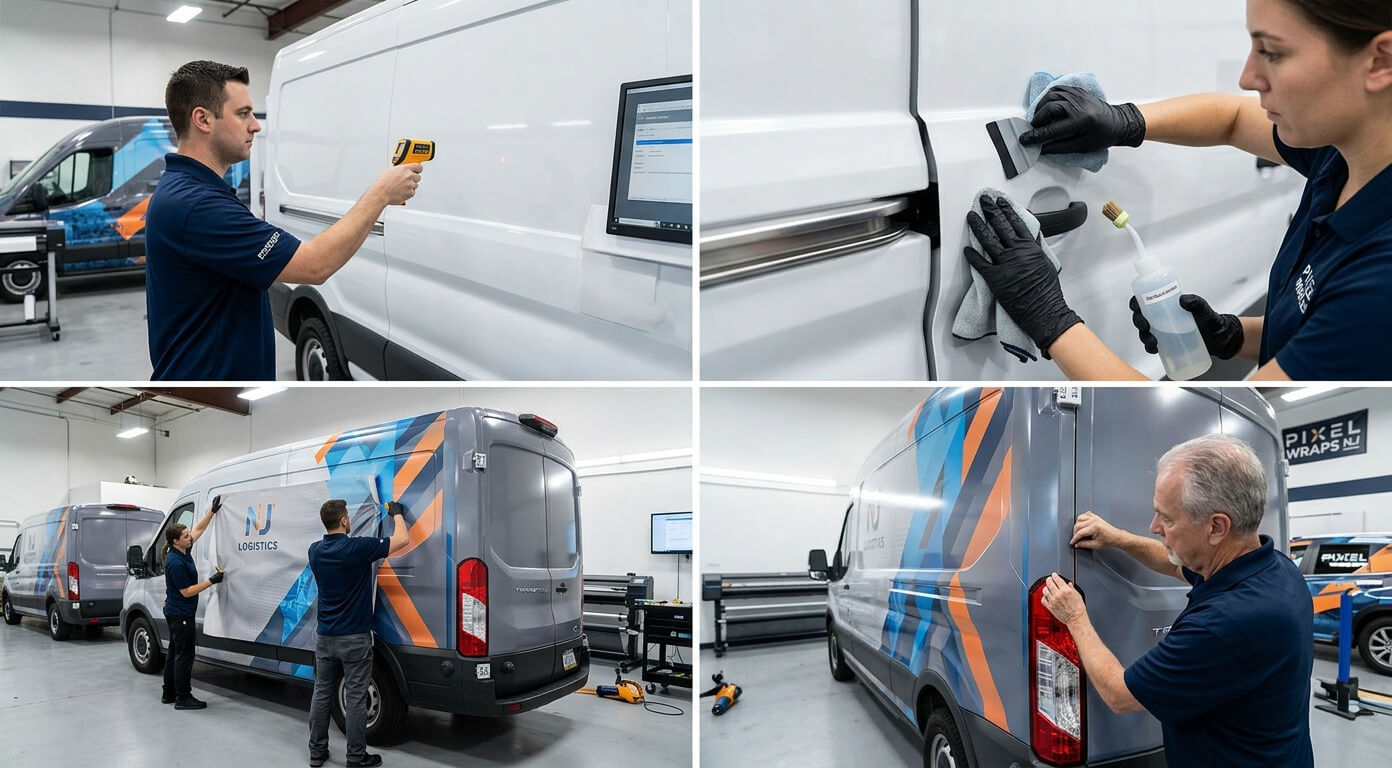
At Pixel Wraps, our installation environment allows us to prepare vehicles, control temperature, inspect surfaces under suitable lighting, and keep the completed wrap indoors when the material requires additional time before weather exposure.
Climate control does not replace skilled installation or correct material selection. It provides the stable conditions those processes need.
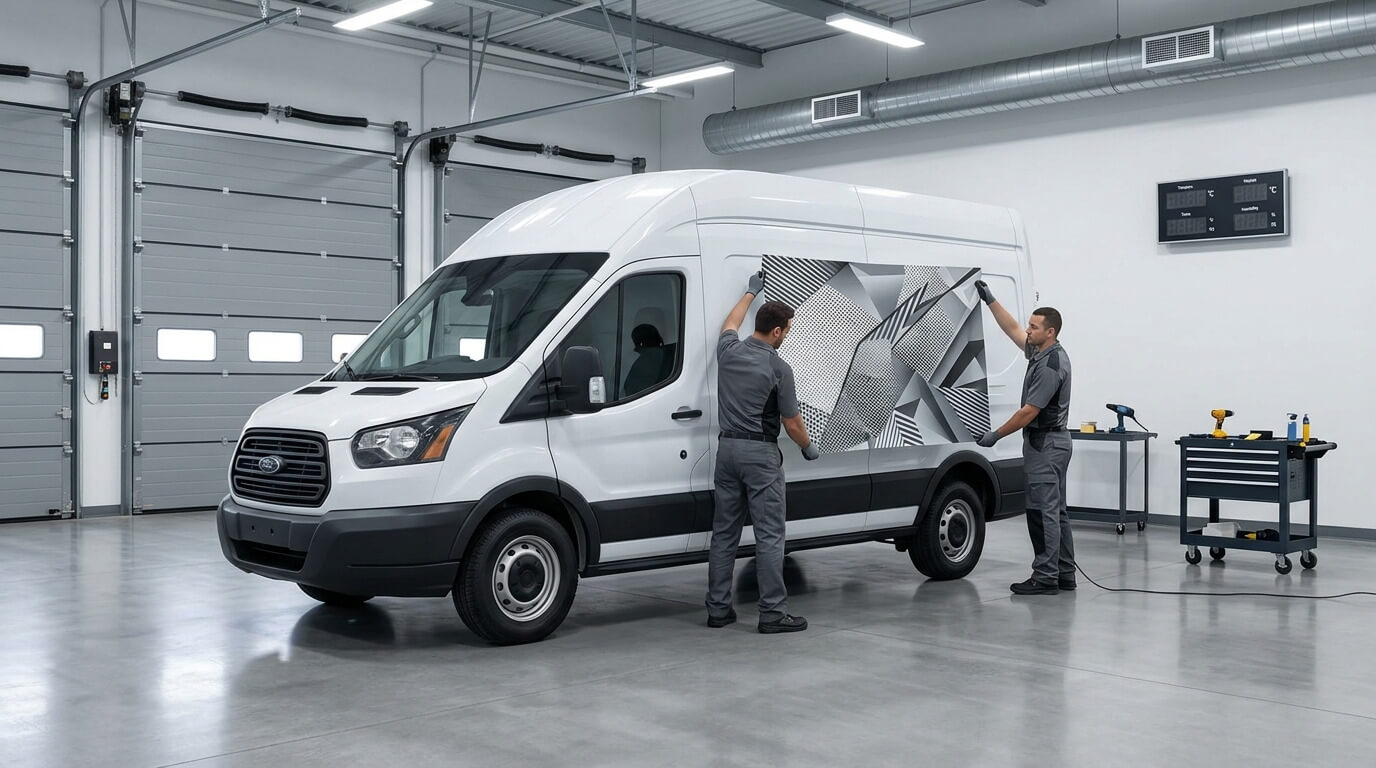
Vehicle-Wrap Adhesives Respond to Temperature
Pressure-sensitive wrap adhesive is designed to bond when the installer applies pressure with a squeegee.
Its behavior changes with temperature.
When the material or vehicle is too cold:
- Vinyl can become stiff
- Adhesive may not flow properly
- Initial bond may be weak
- Air can become harder to remove
- Edges may not seal correctly
- Film may resist conforming around curves
- The material may crack or become brittle in extreme conditions
When the material or surface is too warm:
- Adhesive may grab too aggressively
- Repositioning may become difficult
- Vinyl may stretch more easily than intended
- Large panels can become harder to control
- The installer may introduce excessive tension
- Adhesive can feel softer
The correct range depends on the exact film. Each product has a published minimum application temperature and may include additional instructions for complex vehicle surfaces.
An installer should not use one general temperature rule for every vinyl.
Air Temperature and Surface Temperature Are Different
A warm room does not mean the vehicle is ready for wrapping.
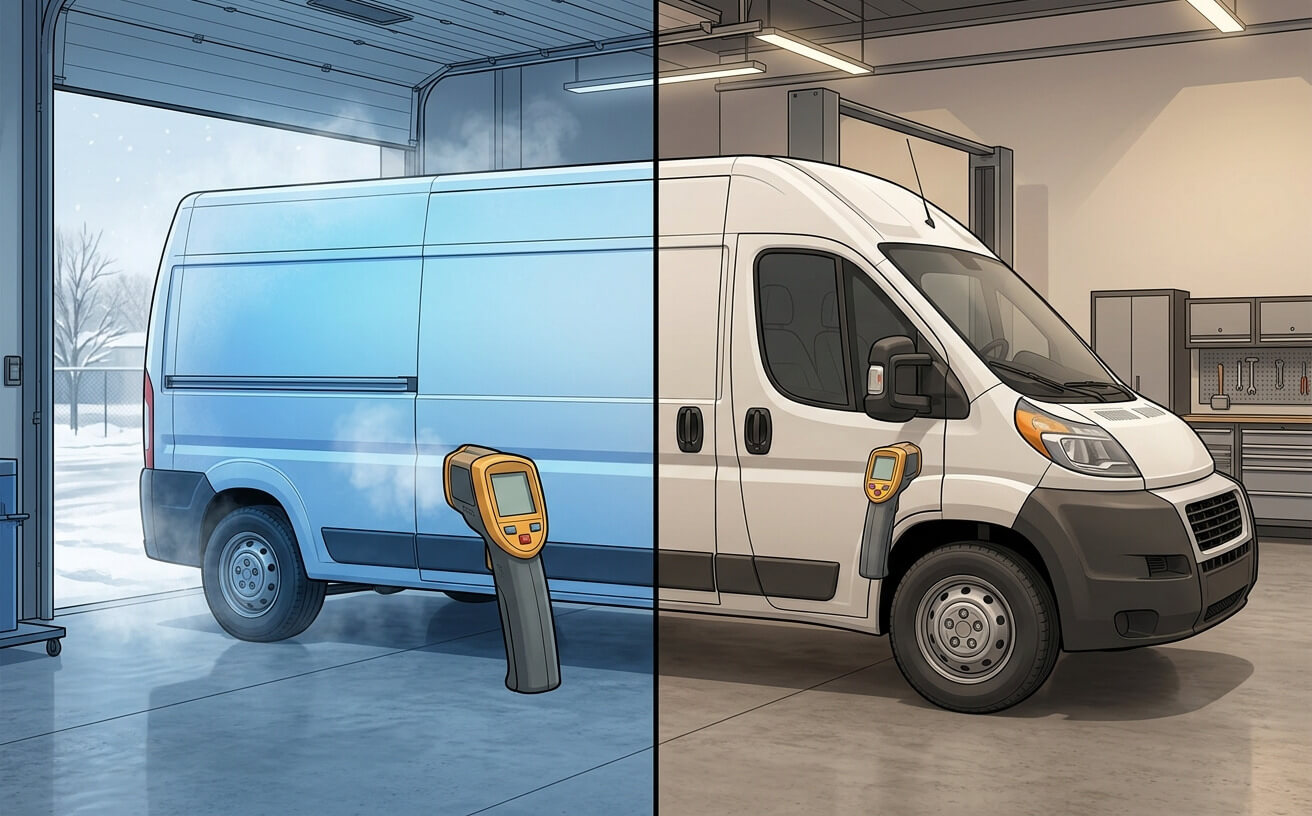
A van driven through freezing winter weather can remain cold for hours after entering the facility. Its metal body, seams, door cavities, and glass may be much colder than the surrounding air.
Similarly, a vehicle parked in direct summer sun may remain hot after being brought indoors.
The relevant conditions include:
- Room temperature
- Vehicle-surface temperature
- Vinyl temperature
- Laminate temperature
- Tool and worktable temperature
- Temperature inside seams and recessed areas
The surface should be measured rather than estimated by touch.
A vehicle may need to remain indoors long enough for its body panels to reach a stable working temperature before cleaning and installation begin.
Product-Specific Application Temperatures Matter
A data sheet may list a minimum application temperature, but that number should not automatically be treated as the ideal working temperature for a full wrap.
The minimum may describe the lowest acceptable temperature under specific conditions. Installation on deep recesses and compound curves can benefit from a more controlled range.
General Formulations’ current AutoMark Vehicle Wrap Application Guide recommends indoor climate-controlled installation and states that the vehicle and environment should be within its identified working range before application. The guide also recommends allowing the vehicle to remain indoors before work begins.
See the General Formulations AutoMark Vehicle Wrap Application Guide.
These recommendations apply to the systems covered by that guide. Other manufacturers and products may provide different requirements.
At Pixel Wraps, we check the technical documentation for the actual film being installed.
Condensation Can Prevent Proper Adhesion
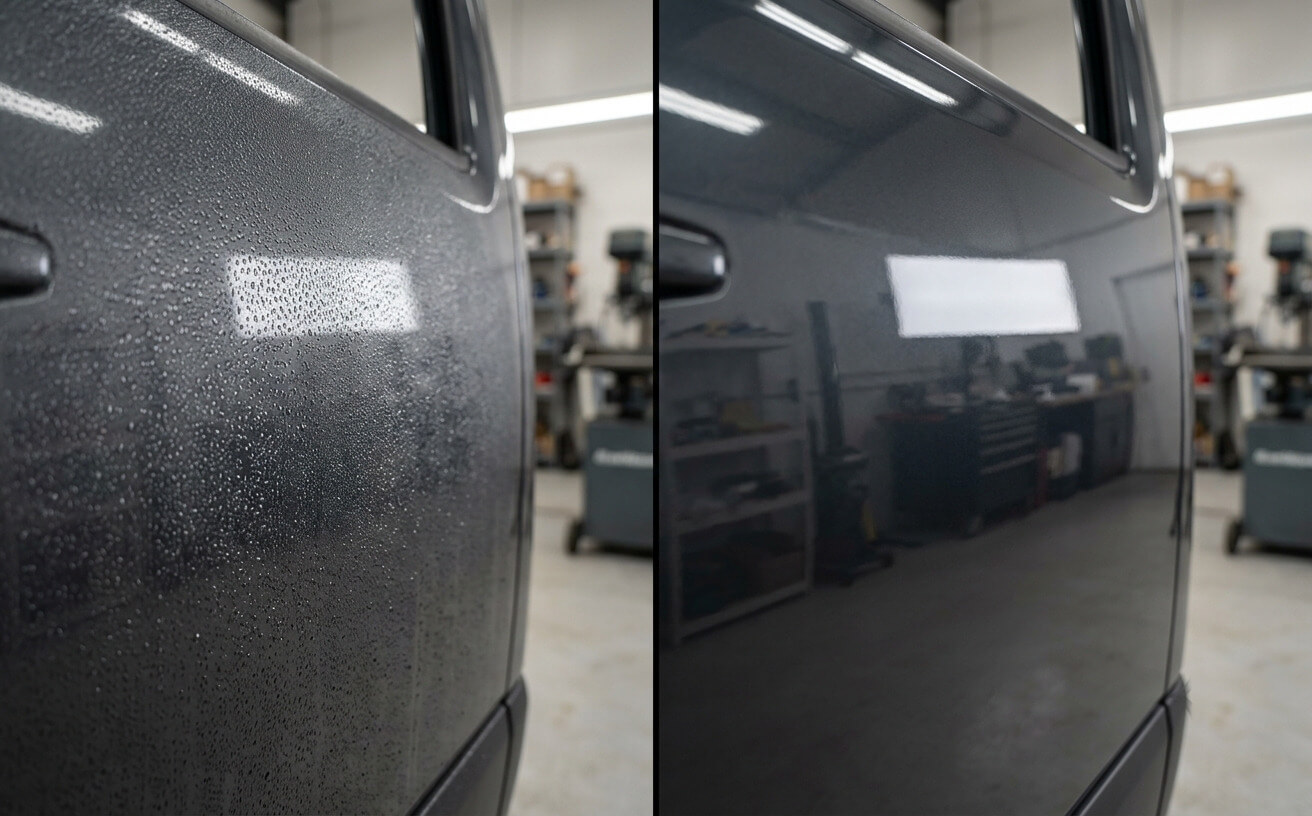
Condensation can form when a cold vehicle enters a warmer, humid space.
The moisture may be obvious as visible droplets, or it may exist as a fine film that is difficult to see.
Moisture can collect:
- Around door handles
- Behind trim
- Inside seams
- Beneath rubber gaskets
- Around lights
- In body channels
- Near mirrors
- Along window edges
- Inside riveted or overlapping panels
If water enters beneath the wrap, it can interfere with adhesion or create bubbles and early edge problems.
3M’s application guidance states that the substrate temperature must remain above the dew point to prevent condensation. It also notes that high humidity can make a surface difficult to keep dry.
See the 3M General Procedures for Interior and Exterior Dry Application.
A vehicle should not be wrapped simply because visible water has been wiped from the largest panels. Hidden areas must also be dry.
Why Dew Point Matters
Dew point is the temperature at which moisture begins condensing from the air onto a surface.
If a vehicle surface is at or below the dew point, moisture can form even when:
- It is not raining
- The room feels comfortable
- The surface was recently wiped
- The installer cannot immediately see droplets
A climate-controlled facility helps keep room temperature and humidity stable so that the vehicle surface can remain safely above the dew point.
This is especially important during:
- Cold winter mornings
- Rapid outdoor-to-indoor temperature changes
- Wet weather
- High-humidity summer days
- Overnight temperature swings
The objective is not to eliminate all humidity. It is to maintain conditions in which the vehicle remains clean and dry throughout preparation and installation.
Climate Control Supports Proper Cleaning
Surface preparation is one of the most important parts of wrap installation.
The vehicle may carry:
- Road salt
- Oil
- Grease
- Wax
- Silicone
- Ceramic coating
- Tire dressing
- Fuel residue
- Tree sap
- Adhesive residue
- Snow-removal chemicals
- Dust
- Moisture
Cleaning products need suitable conditions to work and evaporate correctly.
Cold surfaces can slow evaporation, while high humidity can make complete drying more difficult. Warm, stable conditions allow the installation team to inspect the surface and pay attention to areas where liquid may collect.
The vehicle must be clean before final preparation begins. A climate-controlled bay should not become a wash bay filled with water, mist, and road contamination immediately before wrapping.
Pixel Wraps plans vehicle cleaning, acclimation, disassembly, final surface preparation, and installation as separate stages.
Dust Control Matters
A vehicle wrap does not require a sterile clean room, but the installation area should be clean and protected from uncontrolled traffic, wind, and active dust-producing work.
Dust can become trapped beneath the film and create:
- Visible bumps
- Contamination lines
- Weak points
- Surface scratches
- Rework
- Reduced finish quality
Outdoor installation adds unpredictable sources of contamination:
- Wind
- Pollen
- Sand
- Road dust
- Leaves
- Insects
- Nearby vehicle traffic
- Sudden weather changes
Indoor installation reduces those variables.
The facility should also avoid creating new dust through grinding, sanding, construction, or compressed-air cleaning near an exposed adhesive panel.
Stable Conditions Make Large Panels Easier to Control
Commercial vehicle wraps can use long, wide printed panels.
The installer needs predictable film behavior while:
- Aligning the design
- Sliding the panel
- Repositioning it
- Releasing air
- Managing tension
- Forming the material around contours
- Finishing edges
Rapid temperature changes can make one part of the panel behave differently from another.
For example, direct sunlight through an open bay door may heat one section of a dark printed panel while the rest remains cool. The warmer area may become softer and stretch more easily.
Consistent room and surface conditions allow the installation team to use more controlled pressure, heat, and tension.
Heat Guns Do Not Replace a Warm Vehicle
A heat gun is a finishing and installation tool. It is not a substitute for acclimating an entire cold vehicle.
Applying concentrated heat to a small area of a cold panel can create an uneven condition:
- The vinyl becomes warm
- The surrounding metal remains cold
- Adhesive behavior changes across the panel
- Moisture may remain in seams
- The film may cool rapidly after the tool moves away
Professional installation uses heat according to the film manufacturer’s instructions for conforming, edge finishing, and post-heating.
The goal is controlled heat—not simply making the vinyl hot.
Post-Heating Requires Controlled Conditions
When film is stretched into channels or around complex curves, the installer may need to post-heat specific areas to the manufacturer’s required temperature.
Post-heating helps manage the film’s tendency to return toward its original shape.
It must be:
- Product-specific
- Temperature-controlled
- Applied to the correct areas
- Verified with a suitable temperature-measuring tool
- Followed by inspection and finishing
3M’s technical work concerning IJ280 and its matched overlaminate identifies insufficient post-heating as a factor that can contribute to stress and lifting in recessed applications.
See the 3M IJ280 and 8428G Applied Lifting Technical Report.
A stable installation bay allows the installer to evaluate the post-heated area without wind or rapid surface cooling.
The Wrap May Need Indoor Time After Installation
Adhesive bond develops over time after pressure is applied.
The technical term sometimes used is adhesive wet-out: the adhesive gradually makes more complete contact with the surface.
Sending a newly wrapped vehicle directly into freezing temperatures or heavy rain can interfere with the bond before it has developed as intended.
Post-installation requirements depend on the product and conditions.
General Formulations’ GF 333 AutoMark application guide states that the vehicle and environment should be above its specified temperature before application. It also instructs that a newly wrapped vehicle remain indoors for a defined period when it will be exposed to lower temperatures.
See the GF 333 AutoMark Application Guide.
Pixel Wraps plans release timing around the selected material, season, and weather conditions. A fleet owner should not assume that the vehicle can leave the minute the final panel is trimmed.
Winter Wrap Installation in New Jersey
New Jersey, New York, and Pennsylvania winters create specific installation challenges:
- Cold metal body panels
- Snow and ice
- Road salt
- Moisture in seams
- Frozen door areas
- Heated indoor air with changing humidity
- Immediate exposure to low temperatures after installation
A vehicle arriving after driving on salted roads needs more than a quick surface wipe.
It may require:
- Initial cleaning
- Indoor drying
- Temperature acclimation
- Inspection of seams and hidden areas
- Final surface preparation
- Installation
- Post-installation indoor hold time
These requirements should be included in the production schedule.
A climate-controlled facility allows professional winter installation, but the vehicle still needs enough time for each stage.
Summer Installation Has Different Challenges
Hot weather can also create problems.
A vehicle parked in direct sunlight may have body panels that are much hotter than the surrounding air.
Excessive heat can cause:
- Aggressive initial adhesive grab
- Reduced repositionability
- Vinyl becoming overly soft
- Unintended stretching
- Difficult panel handling
- Faster evaporation of cleaning products
- Uneven behavior between shaded and sunlit panels
Bringing the vehicle indoors allows the surface temperature to stabilize before preparation and installation.
Climate control is not only a winter requirement.
Why Outdoor Wrap Installation Is Risky
An outdoor installer cannot reliably control:
- Surface temperature
- Wind
- Dust
- Pollen
- Rain
- Condensation
- Direct sunlight
- Sudden temperature changes
- Lighting
- Overnight weather exposure
Small decals may sometimes be installed outdoors when the product, surface, weather, and provider’s procedures allow it.
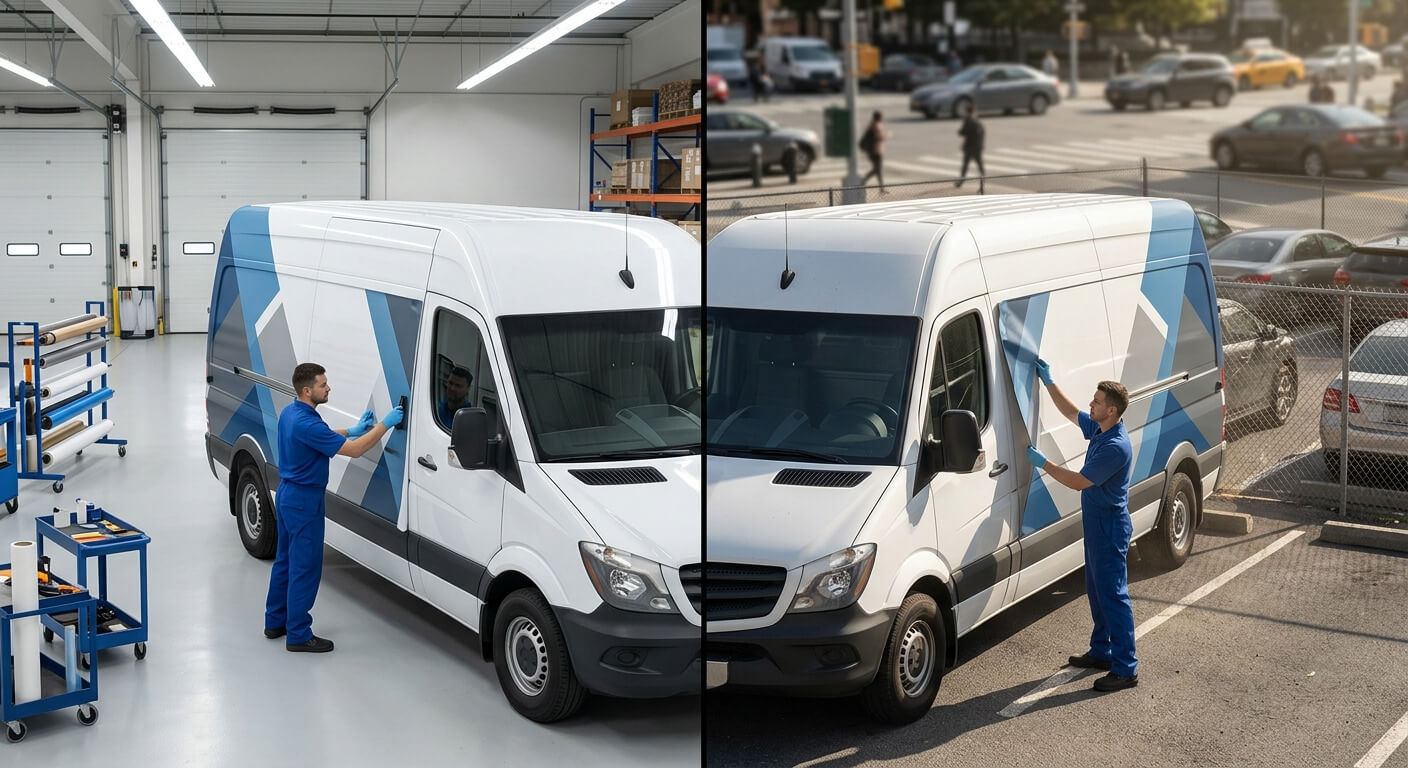
A full commercial vehicle wrap is different. It uses large panels, complex alignment, extensive surface preparation, heat, trimming, and detailed finishing.
General Formulations’ vehicle-wrap guide specifically recommends applying fleet and vehicle graphics indoors because outdoor temperature, moisture, wind, and dust affect engineered adhesive behavior.
For a full or partial fleet wrap, a controlled indoor facility should be considered part of the professional production standard.
Lighting Is Part of the Controlled Environment
Good installation lighting helps technicians see:
- Contamination
- Air pockets
- Wrinkles
- Stretch marks
- Surface damage
- Panel alignment
- Edge placement
- Fine cuts
- Laminate defects
- Color or print problems
Shadows and inconsistent lighting can hide issues until the vehicle is outside.
A professional bay should provide bright, neutral, even illumination around the sides, front, rear, and upper areas of the vehicle.
Portable lights may supplement overhead fixtures for deep channels and lower panels.
Climate control and lighting work together by creating an environment where the installer can repeatedly inspect the graphic under stable conditions.
Climate Control Does Not Fix an Unsuitable Surface
Stable temperature and humidity cannot make vinyl bond reliably to every material.
Problems may still occur on:
- Failing paint
- Rust
- Uncured repainting
- Textured plastic
- Some low-surface-energy plastics
- Silicone contamination
- Ceramic coatings
- Greasy surfaces
- Damaged clear coat
- Porous or corroded panels
The surface and material still need to be compatible.
Climate control provides consistent conditions for evaluating and preparing the vehicle. It does not change the physical condition underneath the wrap.
What Fleet Owners Should Ask the Wrap Provider
| Question | Why it matters |
| Will the vehicle be wrapped indoors? | A controlled interior reduces weather and contamination variables |
| Is the installation area climate-controlled? | Air and surface temperatures affect the adhesive and film |
| How long will the vehicle acclimate before installation? | A cold or hot vehicle may need time to reach a stable temperature |
| Is surface temperature measured? | Room temperature alone does not confirm that the body panels are ready |
| How are seams and hidden areas dried? | Moisture can remain around trim, handles, and channels |
| Is installation separated from dusty production work? | Dust can become trapped beneath the vinyl |
| How is post-heating verified? | Stretched areas may require product-specific finishing temperatures |
| Will the vehicle remain indoors after installation? | Some products and weather conditions require additional bond-development time |
| How does weather affect pickup time? | Immediate cold or wet exposure may change the release schedule |
| What product instructions are being followed? | Application requirements vary between films |
How Pixel Wraps Controls the Installation Environment
Our process considers the environment before the first panel contacts the vehicle.
The workflow can include:
- Scheduling vehicle arrival around weather and cleaning needs
- Bringing the vehicle indoors
- Allowing the surface temperature to stabilize
- Inspecting paint and vehicle condition
- Removing road contamination and moisture
- Performing final surface preparation
- Confirming suitable installation conditions
- Controlling dust and traffic around the work area
- Installing under suitable lighting
- Post-heating and finishing required areas
- Completing a final inspection
- Holding the vehicle indoors when the material or outside conditions require it
This creates more predictable working conditions for our installers and the material system.
Stable Conditions Support a Better Installation
A professional vehicle-wrap material is engineered to perform within defined conditions.
Climate-controlled installation helps provide:
- Stable adhesive behavior
- Flexible, manageable vinyl
- A dry vehicle surface
- Reduced condensation risk
- Better contamination control
- Predictable large-panel handling
- Controlled post-heating
- More consistent finishing
- Suitable post-installation bond development
It is not a marketing extra. It is part of controlling the installation variables.
At Pixel Wraps, we combine a controlled indoor environment with appropriate materials, surface preparation, in-house production, and trained installation practices.
Schedule Your Fleet Installation With Pixel Wraps
When planning a commercial wrap, allow time for more than the physical application.
The schedule may also need to include:
- Vehicle cleaning
- Acclimation
- Drying
- Inspection
- Disassembly
- Surface preparation
- Installation
- Post-heating
- Final inspection
- Indoor post-installation time
Pixel Wraps can coordinate single vehicles and fleet batches around the material requirements, weather, and business operating schedule.
Contact our team to discuss your vehicles, installation timing, and fleet-wrap project.