A vehicle-wrap warranty is not one universal promise covering the vinyl, printing, installation, vehicle paint, and every type of damage.
Most commercial wrap projects involve several different responsibilities. The film manufacturer may provide coverage for qualifying material defects or the performance of an approved graphic system. The wrap provider may separately address production or installation workmanship. The vehicle owner is normally responsible for proper cleaning, maintenance, and reporting problems promptly.
These forms of coverage have different terms, exclusions, claim procedures, and possible remedies.
At Pixel Wraps, we want fleet owners to understand the complete wrap specification—not only the warranty period stated in a proposal. The exact film, laminate, ink, printer, vehicle surface, exposure, installation, and maintenance can all affect coverage.
This guide explains how vehicle-wrap warranties are commonly structured and what businesses should confirm before approving a project.
A Warranty Period Is Not the Same as Wrap Lifespan
A wrap may remain in acceptable condition beyond a stated warranty period, or it may require attention earlier because of damage, exposure, maintenance, or an unsuitable surface.
Several timelines may apply to the same project:
- Manufacturer product durability
- Finished-graphic warranty period
- Adhesive removability period
- Installation workmanship period
- Expected appearance standard
- Customer’s planned replacement cycle
These timelines should not be treated as identical.
A manufacturer may publish an expected performance period for an unprinted film on a flat, vertical outdoor surface. A printed and laminated wrap installed on a vehicle can be subject to different exposure categories and warranty conditions.
The exact technical bulletin and warranty matrix for the selected system should control.
The Four Types of Coverage You May Encounter
Commercial vehicle-wrap proposals can involve four broad forms of coverage.
1. Material Warranty
A material warranty generally addresses defects in the manufactured film or laminate.
Depending on the written terms, examples may include qualifying:
- Cracking
- Excessive shrinkage
- Adhesive failure
- Yellowing
- Delamination
- Other manufacturing defects
Coverage does not mean that every instance of lifting, fading, or cracking is automatically a material defect. The manufacturer may examine whether the product was compatible with the application and processed, installed, exposed, and maintained correctly.
2. Finished-Graphic System Warranty
A system warranty can cover approved combinations of:
- Printable film
- Overlaminate
- Ink
- Printer
- Production process
- Exposure
- Application
3M’s MCS Warranty and Avery Dennison’s ICS Performance Guarantee are examples of manufacturer programs built around qualified graphic systems.
Using one component from a manufacturer does not automatically qualify the entire wrap for that manufacturer’s system warranty.
3. Production and Installation Workmanship Coverage
The graphics provider may separately address issues related to its production or installation work.
Possible examples include qualifying:
- Incorrect panel alignment
- Missed installation areas
- Contamination trapped during production
- Seams that do not match the approved plan
- Edge problems linked to installation
- Production defects not present in the original artwork
The applicable terms should state the coverage period, reporting procedure, exclusions, and remedy.
4. Vehicle or Paint Coverage
Most vehicle-wrap material warranties do not provide a blanket guarantee covering the vehicle’s paint.
Factory paint, repainted panels, clear coat, body filler, corrosion, and previous collision work are outside the vinyl manufacturer’s control.
Paint damage may be excluded when it results from:
- Failing clear coat
- Repainted surfaces
- Poor paint adhesion
- Corrosion
- Existing chips or scratches
- Uncured paint
- Improper removal
- Unknown repair history
Vehicle condition should be documented before installation, but an inspection cannot guarantee the strength of every underlying paint layer.
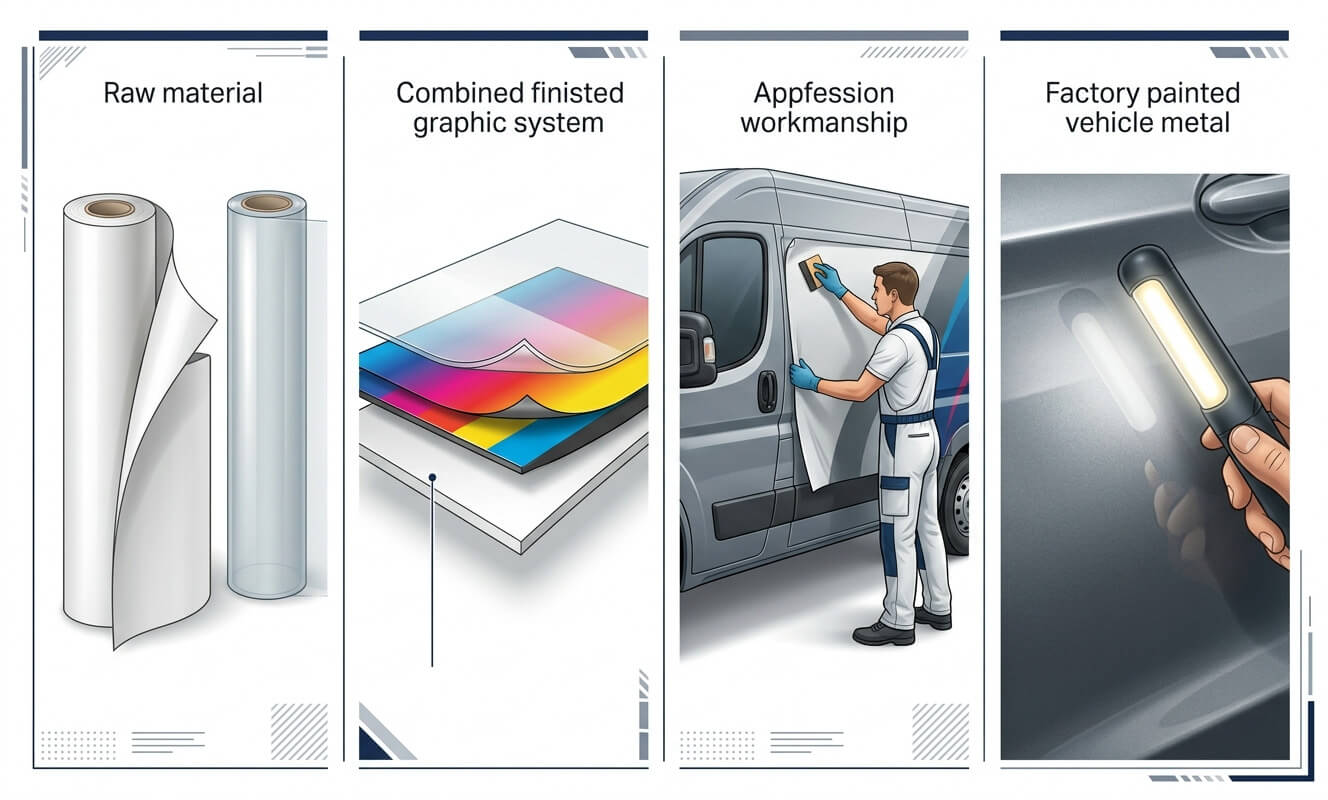
How the 3M MCS Warranty Works
3M’s MCS Warranty is based on approved finished-graphic systems.
According to 3M’s current graphics warranty materials, coverage depends on approved combinations of:
- 3M graphic products
- Eligible inks
- Printers
- Exposures
- Applications
- Production and installation requirements
The applicable warranty matrix determines the period and coverage for the specific construction.
This means a proposal stating “3M vinyl” does not provide enough information to confirm MCS coverage. The quote should identify the exact printable film, laminate, ink and printer system, and intended application.
3M also distinguishes between warranty programs. Coverage may vary depending on whether the finished graphic qualifies for the MCS Warranty, another 3M performance program, or only the base product’s standard warranty.
See the 3M Graphics Warranty Resources and 3M Graphics Warranties Brochure.
How the Avery Dennison ICS Performance Guarantee Works
Avery Dennison’s ICS Performance Guarantee also approaches graphics as a complete system.
Avery explains that the program combines its films with qualified components, printer platforms, inks, and processing materials. The warranty terms require professional processing and compliance with relevant production, application, cleaning, and maintenance instructions.
Again, the Avery Dennison name on the base film is not enough to establish system coverage. The exact construction and application must qualify.
See the Avery Dennison Warranty Program and North American ICS Performance Guarantee Terms.
ORAFOL and General Formulations Warranties
Other professional manufacturers use similar principles.
ORAFOL’s general warranty states that qualifying pressure-sensitive films must be properly stored, processed, and applied, and that their performance is evaluated according to the relevant published technical information.
See the ORAFOL Americas General Warranty.
General Formulations also publishes product-specific application and warranty information. Its technical documents can include conditions related to the vehicle surface, application, removal, adhesive transfer, and other limitations.
For example, the GF 830 AutoMark technical data sheet discusses long-term removability while warning that certain surfaces or conditions may result in adhesive transfer, discoloration, or ghosting that the manufacturer does not guarantee against.
See the GF 830 AutoMark Technical Data Sheet.
These programs should be compared through their written terms—not through broad claims that one manufacturer offers the “best warranty.”
What a Manufacturer Warranty May Cover
Depending on the selected system and written terms, a qualifying manufacturer claim may involve issues such as:
- Defective film
- Defective overlaminate
- Qualifying adhesive failure
- Excessive shrinkage beyond the stated specification
- Qualifying cracking
- Qualifying fading or color change
- Loss of adhesion under approved conditions
- Other failures identified in the warranty documents
The manufacturer may require product samples, photographs, material lot numbers, installation dates, exposure information, and proof that approved components were used.
The available remedy may differ by program and by the age of the graphic.
Possible limited remedies may include:
- Replacement material
- Replacement material plus defined labor
- Prorated compensation
- Another remedy stated in the warranty terms
A warranty does not automatically mean the customer receives a completely new wrap at no cost.
What Is Commonly Excluded?
Exclusions vary, but several categories frequently appear in vehicle-graphics warranty documents.
Vehicle Accidents and Physical Damage
Wrap warranties generally do not cover:
- Collisions
- Dents
- Scrapes
- Rock impacts
- Vandalism
- Cuts
- Cargo damage
- Contact with branches or structures
These are physical-damage or insurance issues rather than manufacturing defects.
Improper Cleaning
Damage can result from:
- Pressure washing too close to edges
- Excessive pressure
- Abrasive brushes
- Strong solvents
- Harsh chemicals
- Scraping ice with sharp tools
- Allowing fuel or contaminants to remain on the wrap
Failure to follow maintenance instructions can affect both appearance and eligibility for coverage.
Horizontal and Nonvertical Exposure
Hoods, roofs, and other horizontal or nearly horizontal surfaces receive greater direct UV and environmental exposure.
Manufacturers may provide different coverage—or no coverage—for these orientations, depending on the system.
A warranty period quoted for vertical vehicle sides should not automatically be applied to a hood or roof.
Unapproved Materials or Combinations
Coverage can be affected when the graphic uses:
- An unapproved laminate
- An incompatible ink
- An unqualified printer
- Mixed components not recognized by the program
- A film outside its intended application
Installation Outside Published Requirements
Possible problems include:
- Installation below the approved temperature
- Incorrect post-heating
- Excessive stretching
- Bridging deep channels
- Inadequate cleaning
- Applying over incompatible surfaces
- Incorrect seam or edge treatment
Preexisting Paint Problems
A manufacturer generally does not control the condition of:
- Repainted panels
- Failing clear coat
- Rust
- Body filler
- Previous adhesive
- Collision repairs
- Uncured paint
Normal Wear and Aging
A warranty is not necessarily an appearance guarantee. Normal wear, gradual aging, environmental staining, and minor changes may fall outside coverage.
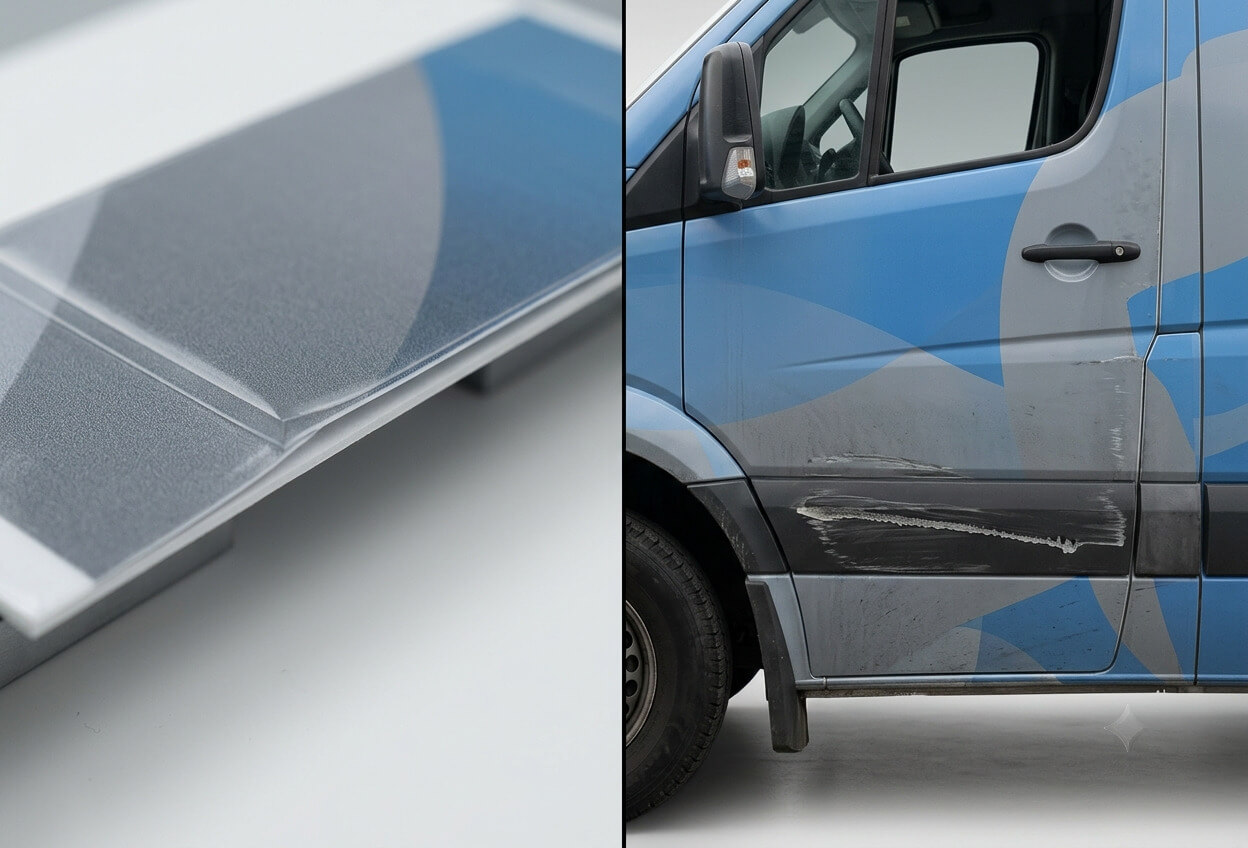
Workmanship Coverage Is Different From Manufacturer Coverage
A manufacturer evaluates its product or qualified graphic system. The wrap provider evaluates its own production and installation work.
The distinction matters because similar symptoms can have different causes.
For example, a lifted edge could result from:
- Contamination during preparation
- Incorrect edge finishing
- Excessive vinyl tension
- An incompatible surface
- Physical contact
- Vehicle body movement
- Chemical exposure
- A material defect
The cause should be investigated before responsibility is assigned.
Businesses should ask the wrap provider for written information about:
- Workmanship coverage period
- Issues included
- Issues excluded
- Required inspection schedule
- Reporting procedure
- Repair process
- Whether travel or vehicle delivery is included
- Whether coverage applies outside the original service area
Pixel Wraps handles project concerns based on the specific material, installation, vehicle condition, and written project terms.
Why Vehicle Documentation Matters
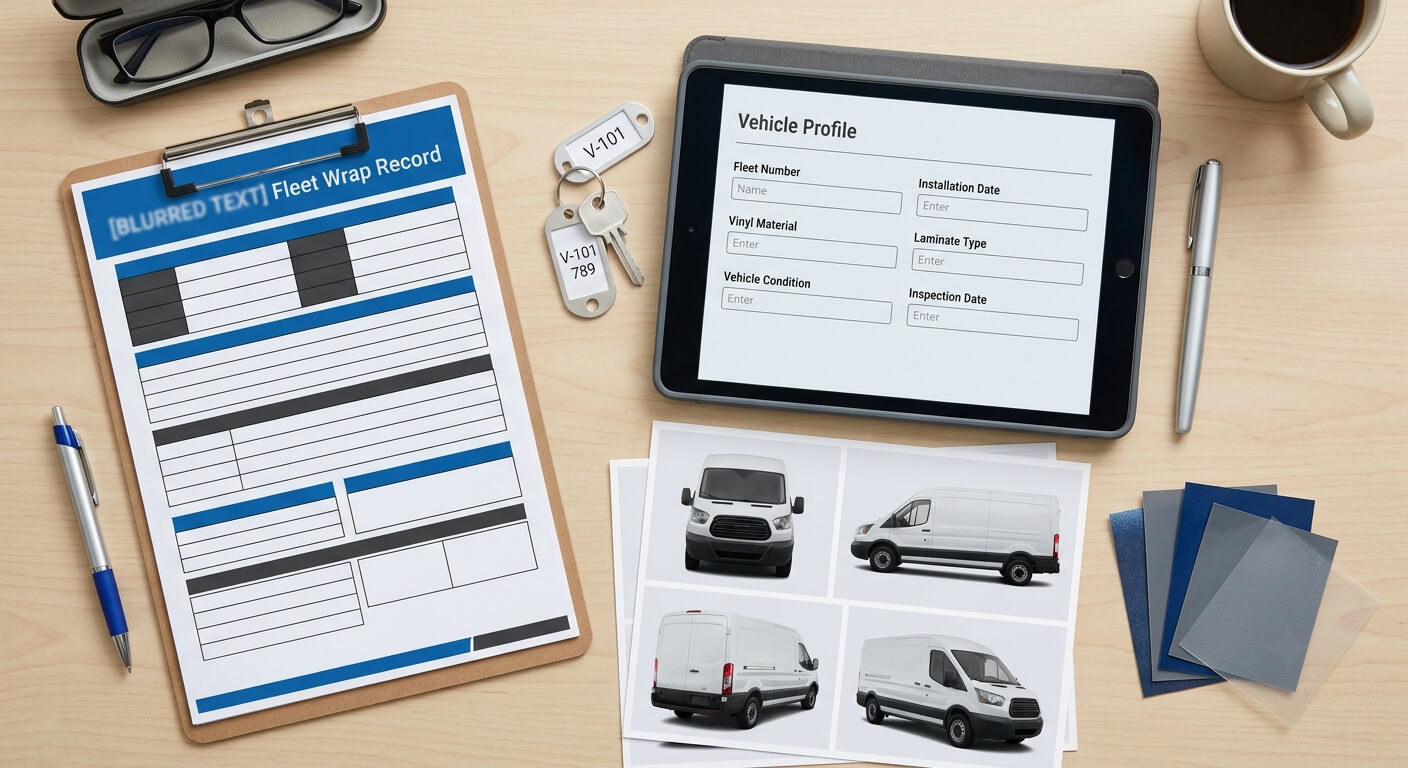
Good records make warranty evaluation faster and more accurate.
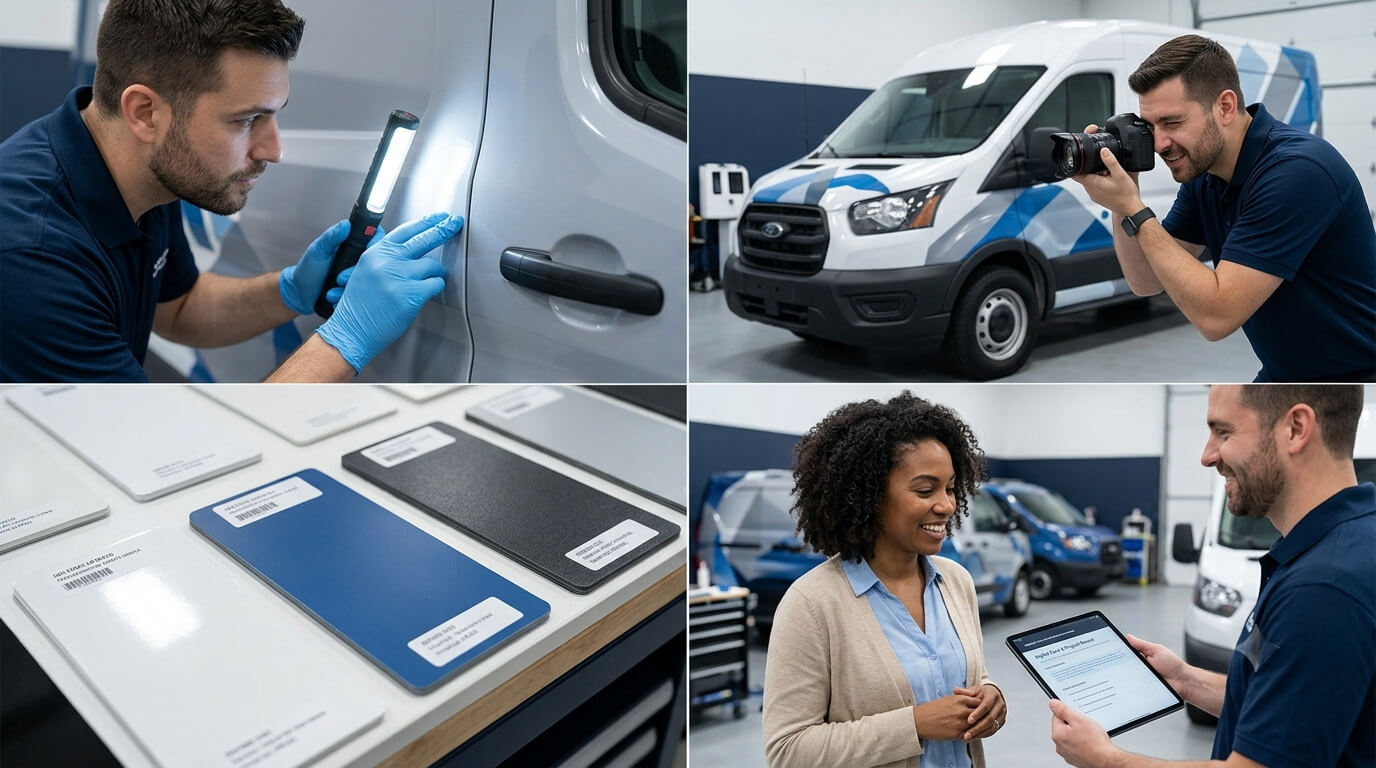
Pixel Wraps recommends maintaining a record for each fleet unit containing:
- Vehicle identification or fleet number
- Year, make, and model
- Vehicle identification number when appropriate
- Installation date
- Surface-condition photographs
- Known repaint or repair history
- Printable film product code
- Laminate product code
- Ink and printer information when required
- Material lot numbers when required
- Installer or installation team
- Cleaning instructions
- Inspection and repair history
- Photographs of any reported problem
For larger fleets, the wrap record should be connected to the company’s vehicle-maintenance or asset-management process.
A claim can become difficult when no one knows which material was used, when it was installed, or whether the damaged panel was previously repaired.
Report Problems Promptly
Fleet owners should not wait until a small problem becomes a large damaged area.
Report concerns when you first notice:
- Edge lifting
- Channel lifting
- Unexpected cracking
- Laminate separation
- Unusual fading
- Adhesive movement
- Significant bubbling
- Panel shrinkage
- Damage around doors or body seams
Prompt reporting allows the wrap provider to:
- Inspect the affected area.
- Determine whether the cause is material, production, installation, vehicle condition, maintenance, or physical damage.
- Prevent a small loose edge from collecting water or road contamination.
- Preserve evidence required for a possible manufacturer claim.
- Recommend repair or replacement.
Do not cut, glue, tape, or pressure-wash a suspected failure before the provider has reviewed it unless immediate safety requires action.
Maintenance Can Affect Warranty Eligibility
The customer normally has continuing responsibilities after installation.
Those responsibilities may include:
- Using approved cleaning methods
- Removing fuel and contaminants promptly
- Avoiding abrasive brushes
- Keeping pressure-washer nozzles at a safe distance and angle
- Avoiding strong solvents
- Inspecting edges periodically
- Reporting damage
- Following special care instructions for matte or specialty finishes
ORAFOL’s vehicle-graphics care guidance recommends mild soap-and-water cleaning and provides specific instructions for maintaining applied graphics.
See the ORAFOL Care and Maintenance of Vehicle Graphics Guide.
Maintenance does not eliminate normal aging, but it can reduce preventable damage and support the documentation required for a claim.
What to Ask Before Approving a Wrap Proposal
A proposal should provide more than “premium vinyl with manufacturer warranty.”
Ask these questions:
| Question | Why it matters |
| What is the exact film product code? | A manufacturer name alone does not identify the coverage |
| What laminate will be used? | The laminate can affect system compatibility and warranty eligibility |
| Which ink and printer are being used? | System warranties may require qualified production components |
| Is this a manufacturer material warranty or a finished-graphic warranty? | The coverage and remedy can be different |
| What workmanship coverage does the installer provide? | Manufacturer coverage does not automatically address installation |
| Are hoods and roofs covered differently? | Nonvertical exposure frequently has separate terms |
| Are repainted panels covered? | Paint and adhesion risks may be excluded |
| What maintenance is required? | Improper cleaning can affect performance and coverage |
| What records will be provided? | Product codes and dates support future claims and repairs |
| What is the remedy if a claim is approved? | Replacement material, labor, and proration can differ |
| Who initiates the manufacturer claim? | The customer should know whom to contact |
| How quickly must a problem be reported? | Delayed reporting can allow damage to spread |
Warning Signs in Warranty Claims
Businesses should be cautious when they encounter statements such as:
- “Lifetime vehicle-wrap warranty”
- “All paint damage is covered”
- “The vinyl is guaranteed never to fade”
- “Any lifting gets a free full rewrap”
- “Every 3M wrap has the same warranty”
- “The manufacturer covers our installation”
- “No maintenance is required”
- “All surfaces are covered”
- “Removal can never damage paint”
These statements omit important conditions.
A credible warranty discussion identifies the exact system, responsible party, coverage period, exclusions, documentation, and remedy.
How Pixel Wraps Approaches Warranty Planning
We reduce avoidable uncertainty by addressing material selection and documentation before installation.
Our process can include:
- Reviewing the vehicle and intended coverage
- Documenting visible surface condition
- Asking about repainting and collision repair
- Selecting an appropriate film-and-laminate system
- Confirming applicable manufacturer documentation
- Controlling printing and lamination in-house
- Following product-specific installation procedures
- Recording project materials
- Providing care guidance
- Evaluating reported concerns based on their actual cause
A warranty is useful, but correct specification and professional installation are the first lines of protection.
Read the Warranty Before You Need It
A vehicle-wrap warranty should be reviewed before production—not after a problem appears.
The most important points are:
- The exact materials being used
- Whether the complete construction qualifies
- Who provides each type of coverage
- How vehicle condition affects coverage
- Required maintenance
- Reporting deadlines
- Exclusions
- Available remedies
Manufacturer programs from 3M, Avery Dennison, ORAFOL, General Formulations, and other established companies can provide meaningful coverage when their requirements are followed.
They are not blanket insurance policies for accidents, poor paint, neglected maintenance, or every change in appearance.
Discuss Your Fleet-Wrap Specification With Pixel Wraps
Pixel Wraps can help your business review the vehicle, material system, production requirements, installation plan, and applicable warranty documentation before work begins.
When requesting a quote, provide information about:
- Vehicle types and quantities
- Repainted or repaired panels
- Expected service period
- Operating area
- Indoor or outdoor parking
- Washing practices
- Required manufacturer or corporate specifications
Contact Pixel Wraps to discuss your commercial fleet-wrap project and receive a proposal based on the actual vehicles and application.