The right vehicle-wrap vinyl is not simply the most expensive film or the product with the longest advertised durability.
A film must match the vehicle’s surface, body shape, graphic coverage, expected service period, operating conditions, and maintenance plan. A material that works well on the flat sides of a box truck may not be appropriate for the deep channels of a cargo van. A film developed for painted metal may also struggle on certain plastic components or unusual finishes.
At Pixel Wraps, we select commercial wrap materials around the complete project. That includes the printable film, adhesive, ink, protective laminate, vehicle condition, production process, and installation method.
This guide explains the major factors businesses should consider when choosing vinyl for commercial vans, trucks, trailers, and mixed fleets.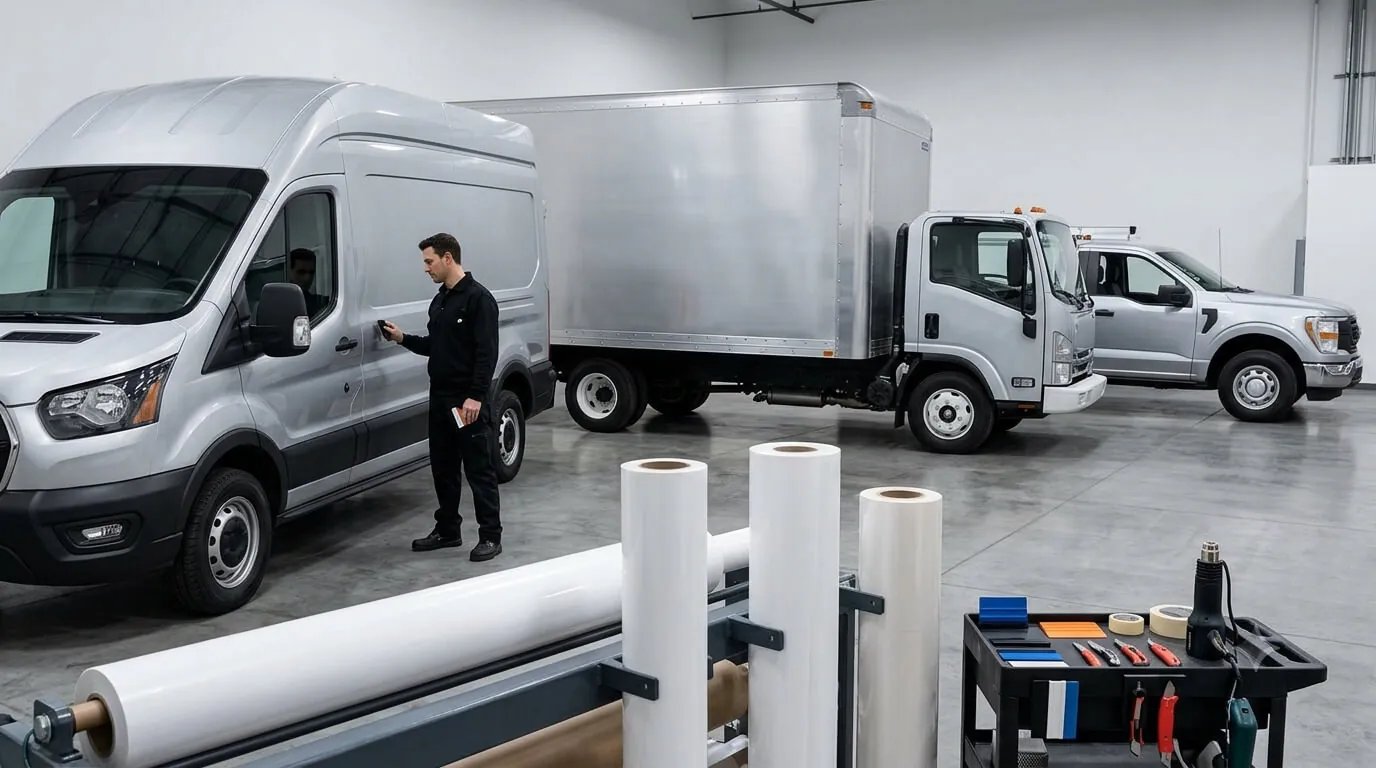
Start With the Intended Application
“Vehicle-wrap vinyl” is not one universal product category.
Manufacturers produce different films for:
- Full printed vehicle wraps
- Partial wraps
- Large printed fleet graphics
- Cut vinyl lettering
- Solid-color change wraps
- Reflective markings
- Temporary promotions
- Flat-sided trucks and trailers
- Complex curves and recessed body panels
- Difficult or low-surface-energy substrates
Before selecting a product, we first define what the vinyl must do.
A plumbing van that will carry the same branding for several years has different requirements from an event vehicle promoting a three-month campaign. A refrigerated box truck with flat panels also presents a different installation environment from a high-roof cargo van with deep channels and compound curves.
Using a product outside its intended application may increase the risk of lifting, shrinking, adhesive residue, difficult removal, or unnecessary expense.
The manufacturer’s current product bulletin should confirm that the film is appropriate for the planned surface and coverage.
Printed Wrap Film Is Different From Solid-Color Wrap Film
Commercial vehicle graphics are usually produced with one of two broad material types.
Printable Vehicle-Wrap Film
Printable film normally begins as white or clear vinyl. The design is printed onto the film with a compatible large-format printer and then protected with an overlaminate.
This is the category commonly used for:
- Company logos
- Phone numbers
- Websites
- Service lists
- Photographs
- Brand patterns
- Full-color advertising
- Coordinated fleet graphics
Professional printable systems include products such as 3M IJ280, Avery Dennison MPI 1105, and ORAFOL ORAJET 3951RA. These examples do not all behave identically, and their technical documentation must be reviewed before specification.
Solid-Color Wrap Film
Solid-color film is manufactured in a finished color, pattern, texture, or effect. It is commonly used for vehicle personalization and color-change work.
Examples include 3M Wrap Film Series 2080, Avery Dennison Supreme Wrapping Film, and ORACAL 970RA.
Solid-color film can be incorporated into some commercial projects, but it does not replace printable film when the design requires detailed branding, photographs, gradients, or extensive business information.
A business should not assume that a popular color-change film is automatically the correct product for a printed fleet wrap.
The official 3M Wrap Film Series 2080 page, Avery Dennison vehicle-wrapping film page, and ORAFOL vehicle-wrapping product catalog illustrate how manufacturers separate printable, solid-color, laminate, and protection-film categories.
Cast Vinyl vs. Calendared Vinyl
One of the most important material decisions is whether the project requires cast or calendared vinyl.
Cast Vinyl
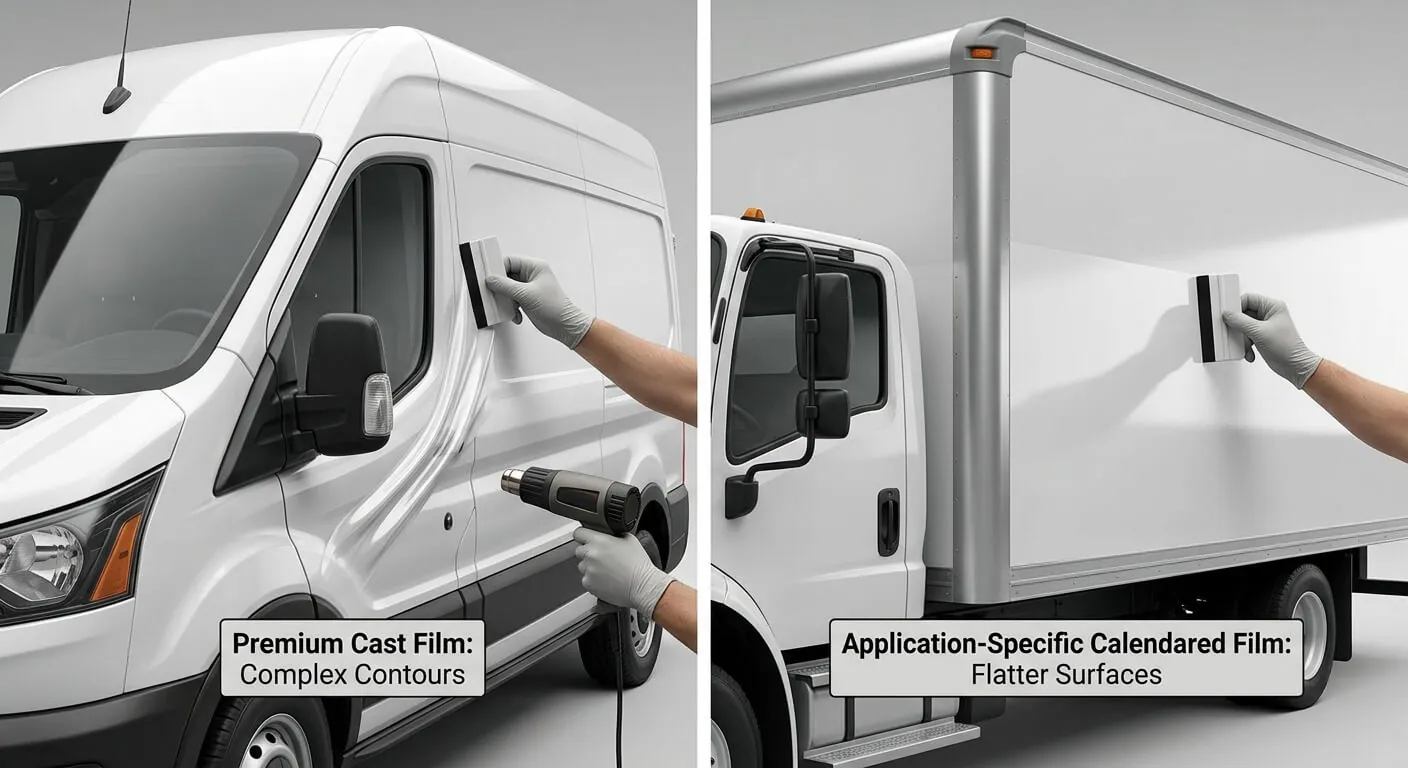
Cast vinyl is generally thinner, more dimensionally stable, and better suited to demanding contours than calendared vinyl. Premium cast films are commonly selected for full vehicle wraps and surfaces with compound curves, channels, and recesses.
Typical applications include:
- Full cargo-van wraps
- Complex body panels
- Long-term fleet graphics
- Curved bumpers
- Deep or compound contours
- Projects requiring a premium conformable system
Cast film still has limits. It can fail when it is overstretched, bridged across recesses, applied to an unsuitable surface, or installed without correct heating and finishing procedures.
Calendared Vinyl
Calendared vinyl is generally thicker and can be suitable for simpler surfaces and certain shorter-term or budget-conscious applications.
Possible applications include:
- Flat vehicle panels
- Basic door graphics
- Simple curves
- Some box trucks and trailers
- Selected short- or medium-term campaigns
Not every calendared film is approved for vehicle applications. A general-purpose sign vinyl should not be placed on a vehicle simply because it is printable and adhesive-backed.
Avery Dennison’s installer study materials describe cast films as the standard choice for demanding vehicle wraps while noting that calendared films can serve certain flat and simple-curve applications. Product-specific technical documentation should still determine the final choice.
See the Avery Dennison vehicle-wrap certification study guide.
Evaluate the Vehicle’s Body Shape
The most demanding area of the vehicle often determines the film specification.
A wrap may look straightforward from a distance but include difficult areas such as:
- Deep stamped channels
- Compound curves
- Wheel arches
- Corrugated panels
- Rivets
- Hinges
- Seams
- Door handles
- Body moldings
- Rounded corners
- Tight transitions between panels
A flat film panel cannot simply be stretched into every shape. When vinyl is stretched, its thickness, color, adhesive coverage, and ability to return to its original shape can be affected.
The correct film must be paired with an installation plan. In some areas, the installer may need to use relief cuts, inlays, overlays, or separate panels rather than forcing one piece of vinyl across the entire surface.
The design also matters. Important text and logos should not be placed where severe stretching, door gaps, handles, or deep recesses will reduce readability.
3M’s current vehicle-application bulletin contains specific procedures for commercial vehicles, contours, and challenging recesses. It also warns that failing to follow the recommended procedures can result in wrinkles, lifting, or other problems.
See the 3M Application: Vehicles Instruction Bulletin.
Identify Every Surface Being Wrapped
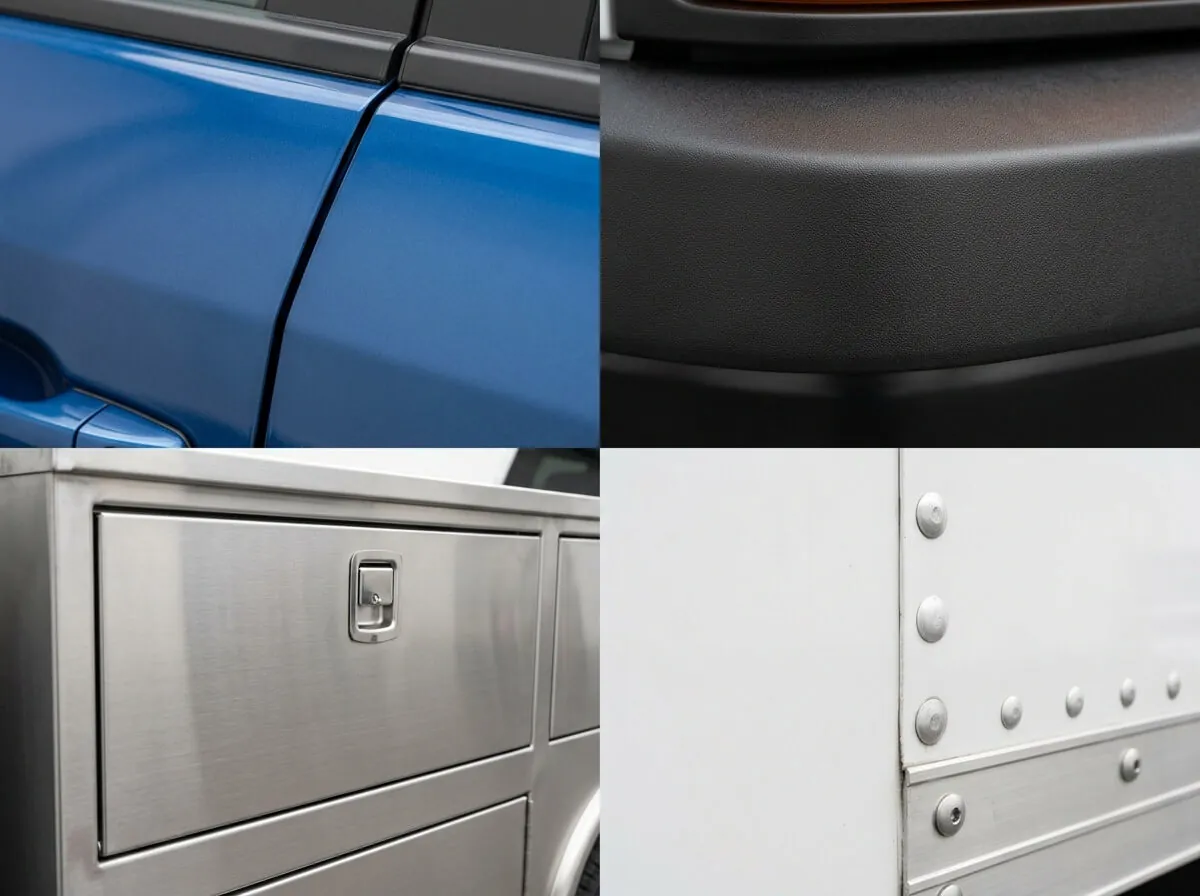
Commercial vehicles contain more than painted body panels.
A design may cross:
- Factory-painted metal
- Repainted metal
- Fiberglass
- Stainless steel
- Aluminum
- Powder-coated surfaces
- Plastic trim
- Rubber seals
- Glass
- Existing graphics
- Riveted or corrugated panels
These surfaces do not provide the same adhesive bond.
Factory Paint
Sound factory paint is usually the preferred vehicle-wrap surface, but it must still be clean, fully cured, and free of waxes, silicones, oils, or contamination.
Repainted Panels
Repainted areas require caution. The wrap provider should know when the repair was performed, what paint system was used, and whether the coating has cured properly.
Vinyl removal can expose weak adhesion between the replacement paint and the surface beneath it.
Plastic Components
Many unpainted plastics have low surface energy, which makes them difficult for ordinary wrap adhesives to bond to. Textured plastic can create an additional problem because the adhesive touches only the raised parts of the surface.
A standard vehicle-wrap film should not automatically be applied to plastic bumpers, textured trim, or molded components without confirming compatibility.
Stainless Steel and Powder-Coated Surfaces
Service bodies, trailers, and specialty vehicles may include stainless steel or powder-coated panels. These surfaces can require a film with a different adhesive formulation.
Manufacturers offer specialized products for some difficult substrates, but choosing a more aggressive adhesive without a valid reason can make removal harder and increase the risk of residue or surface damage.
Glass
Perforated window film is a separate product category. It typically requires an approved optical clear overlaminate and must comply with applicable visibility and vehicle regulations.
A standard opaque wrap film should not cover windows where driver visibility or legal compliance would be affected.
Select the Correct Adhesive
The adhesive is as important as the vinyl face film.
Commercial wrap products may be designed with different levels of:
- Initial tack
- Slideability
- Repositionability
- Air release
- Final bond strength
- Removability
- Compatibility with difficult surfaces
Repositionable Adhesives
Repositionability helps installers align large graphics before final pressure is applied. It is especially useful when placing long printed panels across vans, trucks, and trailers.
Air-Release Adhesives
Air-egress channels allow trapped air to move toward the edge of the panel during installation. They help reduce bubbles, but they do not compensate for poor cleaning or incorrect squeegee technique.
High-Tack Adhesives
High-tack films are designed for selected hard-to-stick surfaces. They should not be treated as a universal upgrade.
Using an unnecessarily aggressive adhesive on painted vehicle panels can make repositioning and eventual removal more difficult. The product must be approved for both the surface and the intended service period.
Removable Adhesives
The word “removable” has conditions. Removal performance may depend on the product, surface, exposure, age of the graphic, removal temperature, and paint condition.
No adhesive specification can guarantee damage-free removal from failing clear coat, uncured paint, poorly repaired bodywork, or unstable coatings.
Match the Film to the Expected Service Period
How long should the graphics remain on the vehicle?
That question affects material cost, adhesive selection, laminate choice, and removal planning.
Short-Term Campaigns
A temporary promotion may prioritize:
- Clean removal within a defined period
- Lower material cost
- Fast production
- Simple coverage
- Limited exposure
- A known campaign end date
A long-term premium cast system may be unnecessary for a short campaign on flat surfaces. However, using a cheap general-purpose film can create removal problems that outweigh the initial savings.
Long-Term Fleet Graphics
A longer-term wrap may place greater importance on:
- Dimensional stability
- Conformability
- UV resistance
- Compatible cast laminate
- Long-term appearance
- Reliable edge performance
- Repair and replacement planning
Published durability is not the same as guaranteed service life. Horizontal exposure, climate, vehicle storage, washing, road use, and maintenance can shorten real-world performance.
Pixel Wraps looks at the expected removal date before recommending the material. We do not assume that every commercial vehicle needs the same long-term system.
Consider Where the Vehicle Operates and Parks
Two identical wraps can age differently when they operate in different conditions.
Important exposure factors include:
- Direct sunlight
- High summer temperatures
- Freeze-and-thaw cycles
- Road salt
- Snow and ice
- Coastal air
- Industrial contamination
- Tree sap and bird residue
- Frequent highway driving
- Indoor or outdoor parking
- Orientation of each wrapped panel
Horizontal and nearly horizontal surfaces often receive more direct ultraviolet and environmental exposure than vertical doors and body sides.
A vehicle parked indoors overnight may experience different aging from one parked outside throughout the year. A fleet traveling through New Jersey, New York, and Pennsylvania also encounters seasonal temperature changes, road salt, and winter cleaning demands.
The material recommendation should reflect how the fleet actually operates—not only how the vehicle looks inside the installation facility.
Choose the Film and Laminate Together
Printed commercial graphics normally need a protective overlaminate.
The laminate can influence:
- UV protection
- Abrasion resistance
- Chemical resistance
- Surface finish
- Conformability
- Film thickness
- Installation behavior
- Warranty eligibility
Manufacturers usually identify compatible film-and-laminate combinations. For example, ORAFOL’s vehicle-wrapping catalog separates digital print films from laminating films, while 3M and Avery Dennison publish system-specific product and warranty documentation.
The laminate should not be selected only by appearance. A thick or incompatible laminate can change how the complete construction conforms around curves and channels.
At Pixel Wraps, we specify the print film, ink, and laminate as one production system. We also allow printed graphics to process correctly before lamination and installation.
Account for the Design and Print Requirements
Material selection and graphic design should happen together.
A wrap design with large areas of dark ink, fine gradients, photographs, or strict corporate colors may require additional print testing and color management.
Our production team considers:
- Printer compatibility
- Approved ink technology
- Media profiles
- Ink saturation
- Drying or outgassing requirements
- Lamination timing
- Panel overlap
- Color consistency
- Future reprints
- Material lot tracking when required
A wrap can use excellent vinyl and still produce a poor result if the ink is not processed correctly or the laminate is applied too early.
For fleets, we also maintain production information where practical. If a vehicle is added later or a door is damaged, those records can help us reproduce the original graphics more consistently.
Do Not Select Vinyl by Durability Number Alone
A product described as having a certain maximum durability does not necessarily provide that same service life on every part of every vehicle.
Published durability may change according to:
- Vertical or horizontal orientation
- Geographic exposure zone
- Film color
- Print and ink coverage
- Laminate
- Application surface
- Maintenance
- Installation conditions
- Whether the product is used as an approved system
The maximum number in a product brochure should not be converted into a blanket promise.
We review the current product bulletin, warranty terms, exposure definitions, and limitations for the exact construction being considered.
Consider Maintenance Before Installation
The customer’s cleaning practices can influence the material choice and expected appearance.
Before specifying the wrap, it helps to know:
- How frequently the vehicles are washed
- Whether they use automatic or manual washing
- Whether pressure washing is involved
- What chemicals the fleet uses
- Whether vehicles are exposed to fuel, grease, or industrial residue
- Whether drivers can report edge damage promptly
Strong solvents, stiff brushes, aggressive pressure washing, and neglected contaminants can damage graphics.
Avery Dennison’s official maintenance guidance recommends testing cleaning products on a small, inconspicuous area and recognizes that different finishes may respond differently to care products.
See the Avery Dennison Vehicle Wrap Cleaning and Maintenance Bulletin.
Use a Matched Manufacturer System When Warranty Matters
Manufacturer warranties usually depend on more than the base film.
Eligibility may involve:
- Approved printable film
- Approved overlaminate
- Approved ink
- Qualified printer platform
- Correct production procedures
- Suitable substrate
- Approved application
- Geographic exposure
- Installation documentation
- Maintenance compliance
Mixing components from different manufacturers is not automatically prohibited for every application, but it may affect system-level warranty coverage.
Businesses that require a specific manufacturer warranty should communicate that requirement before design and production begin.
The applicable warranty documents—not a general marketing claim—should establish the actual coverage.
Our Commercial Vehicle-Wrap Material Checklist
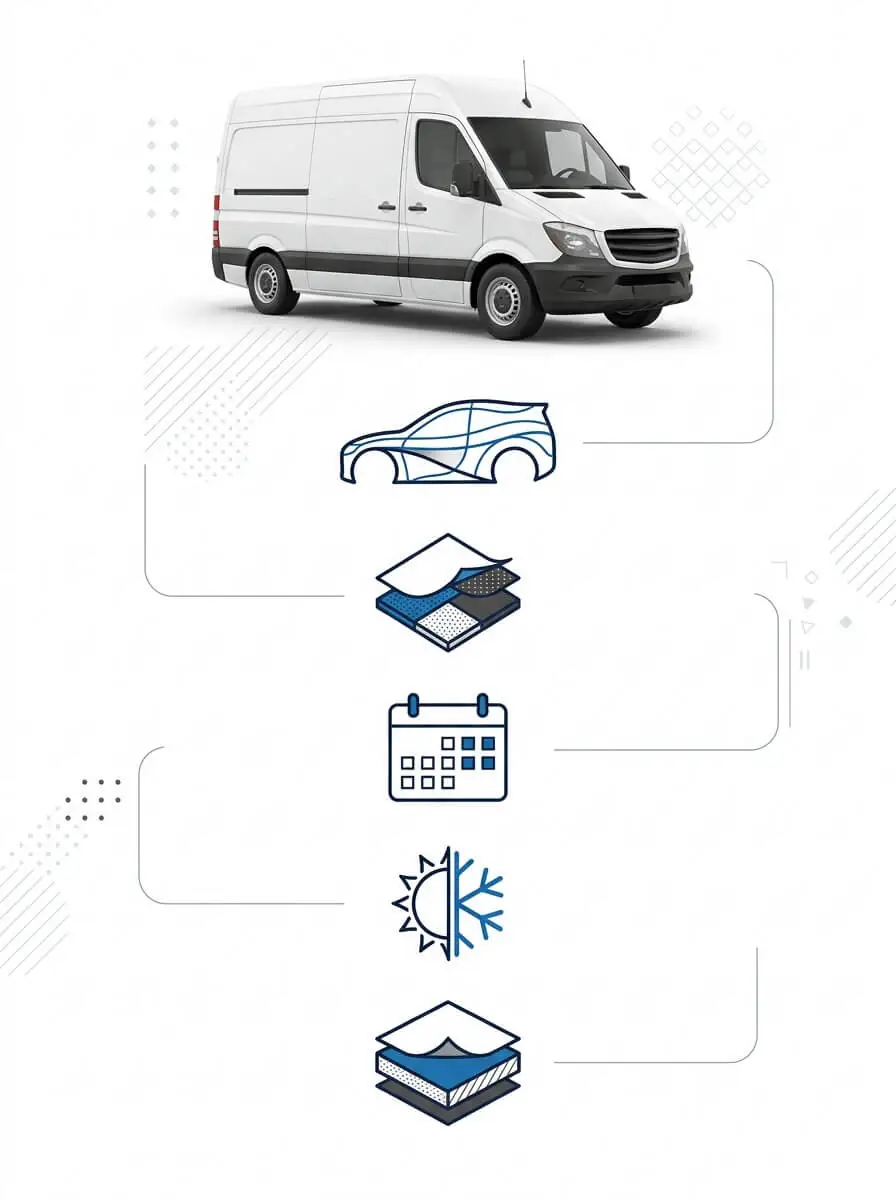
Before Pixel Wraps recommends a vinyl, we evaluate the following questions.
| Project factor | What we need to know | Why it matters |
| Vehicle type | Van, pickup, box truck, trailer, bus, or specialty vehicle | Each body style presents different surfaces and contours |
| Surface condition | Factory paint, repaint, corrosion, repairs, or existing graphics | Adhesion and removal depend on the condition underneath |
| Surface material | Painted metal, plastic, stainless steel, aluminum, fiberglass, or glass | Different substrates may require different adhesives |
| Graphic coverage | Lettering, spot graphics, partial wrap, or full wrap | Coverage affects film category, production, and installation |
| Body complexity | Flat panels, simple curves, recesses, rivets, or corrugations | Complex areas usually require a more conformable film |
| Service period | Months, several years, or an open-ended fleet program | Duration influences film, adhesive, and laminate selection |
| Operating environment | Sun, winter weather, road salt, industrial exposure, or indoor storage | Exposure affects aging and maintenance requirements |
| Removal plan | Planned campaign date, resale, lease return, or fleet rebranding | Removal should be considered before installation |
| Brand requirements | Finish, colors, warranty, and approved material specifications | Corporate standards may limit the available systems |
| Future vehicles | One vehicle or an expanding fleet | Documentation and material availability support consistency |
Common Material-Selection Mistakes
Choosing the Cheapest Printable Vinyl
A low material price does not guarantee a low total project cost. Premature replacement, difficult removal, lifting edges, or repeated downtime can erase the initial savings.
Assuming Premium Cast Film Solves Every Problem
Premium cast vinyl is a strong choice for demanding wraps, but it cannot stabilize failing paint, bond reliably to every plastic, or correct poor installation.
Using High-Tack Film Everywhere
High-tack adhesive should be selected for a confirmed application need. It is not automatically better for factory-painted vehicle panels.
Ignoring the Laminate
The printed film and laminate operate as one construction. Selecting them separately without checking compatibility can affect conformability and warranty eligibility.
Treating Every Fleet Vehicle the Same
A mixed fleet may require more than one material specification. The goal is consistent branding, not forcing the same product onto incompatible surfaces.
Relying Only on the Product Name
Manufacturers offer variants with different adhesive colors, tack levels, air-release patterns, and surface compatibility. The complete product code and current technical bulletin matter.
Why Professional Installation Still Matters
The correct vinyl can still fail when the vehicle is poorly prepared or the film is installed incorrectly.
Professional installation includes:
- Inspecting and documenting the surface
- Removing oils, waxes, and contamination
- Planning seams and overlaps
- Controlling installation temperature
- Managing stretch
- Using heat appropriately
- Post-heating required areas
- Finishing edges correctly
- Allowing for door movement and body seams
- Recording the materials used
3M’s vehicle-preparation guide emphasizes inspection, cleaning, and preparation before wrap installation. These steps are necessary even when using a premium film.
See the 3M Vehicle Prep for Success Guide.
At Pixel Wraps, our in-house workflow connects design, printing, lamination, and installation. That allows our designers to account for the vehicle’s difficult areas and lets our installation team understand the intended panel plan before the vehicle enters production.
There Is No Single Best Vinyl for Every Commercial Vehicle
The best material is the one correctly matched to the project.
A premium cast printable system may be appropriate for a long-term full wrap on a contoured cargo van. An application-specific calendared film may make more sense for selected flat graphics. A difficult surface may need a specialized adhesive, while a short campaign may require a product designed around predictable removal.
The decision should be based on:
- The exact vehicle and surface
- The shape and complexity of the body
- The required graphic coverage
- The intended service period
- The environment and maintenance plan
- The complete print-and-laminate system
- The manufacturer’s current documentation
- The installer’s experience with the proposed construction
Brand recognition alone is not enough.
Pixel Wraps works with professional materials from 3M, Avery Dennison, ORAFOL, and other established manufacturers. We recommend the system that fits the commercial application instead of forcing every fleet into one product line.
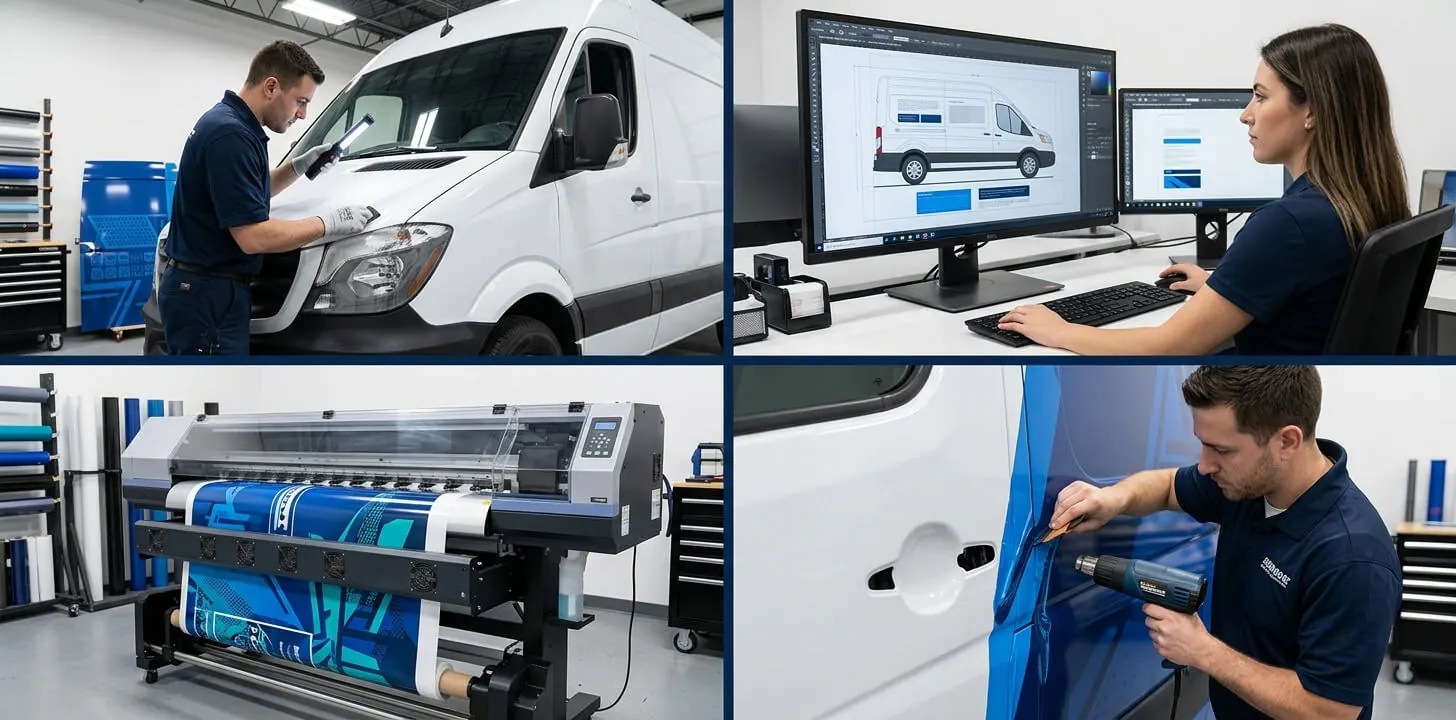
Visual Production Brief 5: Pixel Wraps Material Consultation
Placement: Immediately above the final call to action
Purpose: Show the real evaluation and production process behind a professional material recommendation.
Recommended Format: Wide four-image collage, approximately 1800 × 1000 pixels
Detailed AI Image Prompt:
“Documentary-style commercial vehicle-wrap production collage inside a professional New Jersey graphics facility. Four scenes: technician inspecting a white cargo van body panel under bright lights, designer reviewing a vehicle template on a large monitor, large-format printer producing blue fleet graphics, and professional installer finishing vinyl around a van-door contour. Clean organized facility, realistic tools and equipment, natural commercial photography, navy and charcoal brand palette, no fake logos, no readable text, no malformed hands.”
Designer Notes: Use authentic Pixel Wraps photography for this section whenever possible. Suggested real images include vehicle inspection, design proofing, printing, lamination, and installation. If AI is used for a placeholder, it must not be labeled as the Pixel Wraps team or facility.
Get the Right Wrap Specification for Your Fleet
If you are comparing vehicle-wrap quotes, ask for more than a manufacturer’s name.
Request information about:
- The exact printable film
- The adhesive type
- The matching laminate
- The intended service period
- Surface compatibility
- Installation procedures
- Warranty conditions
- Removal expectations
Pixel Wraps can inspect your vehicles and recommend a commercial wrap system based on the surface, body design, operating environment, and business goals.
Contact our team to discuss your fleet and receive a material recommendation built around the actual application.
How to Choose Commercial Vehicle-Wrap Vinyl | Pixel Wraps